‘I want to thrive, not just survive’ by Dr Steven Graham

It is March 16th in Phnom Penh, Cambodia and having completed two classes in the morning, I am told that the university is closed because of Corona Virus. Looks like my afternoon class is going to be a bit different from what I had planned. Take a deep breath, pour myself another coffee and think about how to deliver the afternoon class.

I am sure many of you have had similar experiences where you have had to adapt and overcome problems at work, but this pandemic has hit every country around the world to different degrees. How we react to these situations can be the difference in thriving rather than just surviving.

Our university had made plans for this day, but I do not think any of us really thought that we would close our doors to students and that we would be teaching completely online. The faculty had undergone some training in the event of closure, but with most things like this, we are confronted with a myriad of apps, platforms, and conferencing tools. I certainly felt pressured to use all of them, as I want to do a good job and I do not want to let down my students.

Of course, just because the tools are there, does not mean that you have to use them. For example, there is Zoom and Skype, not to mention Facebook and Canvas, our learning platform. The decision as to which tools to use should not be the teacher’s decision alone. I left this decision to my students. They told me what they liked and how they wanted to contact me, so I used an eclectic approach, and used what the students wanted, within reason of course. This allowed students to complete assignments as normal and made it possible for me to record their progress using our learning platform and give timely feedback too.

Most of us have had some kind of experience with online teaching or some of the tools that assist with distance learning. I suppose I was one of the lucky ones as our university partners with universities from the US, and I have taught courses as a Global Professor for the University of Arizona. This had given me an insight as to how other universities conducted their online learning before the pandemic started and had given me ideas as to how to incorporate online learning tools with my teaching of face to face classes previously.

When the university closed, I was teaching an oral communication course. I had three sections of students with approximately thirty students in each section. This is a really good number when debating in class, but a problem when teaching online. Having listened to how the students wanted to learn, I was able to use Facebook and Zoom to complete the assignments.

Facebook was used for group discussions and then the posting of videos showing portions of debates. Students were able to review the videos before making their replies and posting their videos. At the same time I was a member of the group and I could facilitate the procedure and give feedback as the students practised the process and became more comfortable with their roles. Once confident, students were able to use Zoom to conduct their debates live. This was recorded and uploaded to our learning platform as evidence of completion of the assignment. I could not participate in all their debates at the same time, but the uploaded videos allowed me to grade and offer feedback that evening.

Presentations were not an obstacle, with students finding it easy to record themselves giving physical presentations as well as recording slideshows with audio in PowerPoint. YouTube has many self-help videos and most importantly, the students know this and know where to find them.

It is interesting to reflect on this process and recall how the students were very tentative at the beginning; however, the more they practiced, the better they became, and confidence levels grew. There was a feeling that we were all in this together and we were battling to survive and get to the end of the semester. As the course progressed and students became more confident, they began to flourish, and the course became less about survival and more about improving performances and ultimately grades.

The business correspondence course which followed was another story. A different class with different students presented different problems. Writing and researching for a case study caused the students difficulties and so I had to change the way I taught. Instructions were posted in the learning platform as usual, but the students wanted more than that. I ended up making my normal videos and uploading them so the students can watch in their own time, with the instructions once more. In addition, I also conducted live conference meetings where I could explain once again what was required for the assignment. This meant that I presented three times in three different ways for each assignment. Some students had weak internet connections, so having videos proved useful.

I have always encouraged questions in my classes. This could be completed in many ways depending on what the students wanted. Some would want to use email, others wanted to chat on Facebook. Some wanted face-to-face contact on Facebook or Zoom, it did not really matter as far as I was concerned, but it did matter to the students. They wanted to thrive as well as me, and what I learned was that if the students thrived, then so did I.

Now the university is looking forward to opening soon, but we do not know exactly when that will be. When I look at our journey that we have completed together, I have learned a lot and so have my students. Some of the lessons were not in the schema of work, but now they are. Digital literacy, critical thinking and time management have never been so important, for both students and their teachers.


About Dr Steven Graham

Dr Steven Graham is an Assistant Professor and English Preparatory Program Director at the American University of Phnom Penh (AUPP), Cambodia and a founding member of Udon Education Foundation (UEF) in Udon Thani, Thailand. His main interests are in English for Specific Purposes (ESP), English for Academic Purposes (EAP), teacher training, primary school teaching and learning materials, and speech recognition development and implementation. Steven has published extensively and is a frequent presenter at national seminars and international conferences. He reviews books and has also been a regular contributor to the Bangkok Post in Thailand.


Contribute to the blog

If you are a member of IATEFL and would like to contribute to the blog, we’d love to hear from you at [email protected]. We’re looking for stories from our members, news about projects you’ve been involved in, and anything else you think those connected to English language teaching would be interested in reading. We look forward to hearing from you! If you’re not a member, why not join us?

See VIEWS Guidelines and Ideas

‘Surviving professionally during Covid-19’ by Krishna Prasad Parajuli

During the lockdown period, I was confined to my house in a remote village about 60 kilometers away from Kathmandu, the capital city of Nepal. My village had electricity and a mobile network but not broadband internet service. Within the house, only the 2G network was available. I often went to the rooftop where I could access the 3G network. The 4G network was not available on my network. Initially I just checked my email as the mobile internet service was expensive and recharge cards were not easily available. So, I just used the mobile internet service to retrieve essential documents from the cloud and (to) update emails.

After one month of lockdown, my campus asked me to continue to provide learning support to my students.  I started to reflect on the opportunities and challenges of my online teaching. I completed an online teacher training course from the University of Oregon in asynchronous mode in 2013. My M. Phil. study at the Nepal Open University on open and distance learning with synchronous and asynchronous modes is currently underway. I have learned about the opportunities and limitations of virtual learning environments from these programs. I am familiar with Moodle, Skype for Business, Microsoft Teams, Google Classroom, and Google Sites as online learning tools.

I had arrived at my home just a few days prior to the lockdown. I had not expected the possibility of a lockdown. I went home without any resources to attend to a family matter. I had several challenges to teach remotely because I was not mentally and physically prepared to take classes from my home:  I did not have broadband internet service, my internet service was unreliable, I did not have a laptop, my students did not have access to MS team or Moodle,  I did not have virtual teaching experience and my students did not have any experience with virtual learning, and finally,  I did not have a course book.  For two weeks, I was reluctant to teach because of the poor internet network and the cost of the mobile network. However, my mobile service provider announced availability of the mobile internet service pack at a discounted rate for teachers and students. My university recommended me for this discounted package.  

I decided to beat the challenges. I found that my smart phone got a stronger signal on the roof of the house and that the 3G service was available there. So, I decided to place it on the roof and make it a Wi-Fi hotspot for other devices. I bought a 15 GB mobile internet pack for four weeks. Now I did not need to worry about the internet. However, my internet service was unstable. I found that if I reconnected the devices with the mobile data service, I would get a stronger internet signal on my smart phone. I learned to reset the mobile data service to enable a signal. I managed to borrow a laptop from my brother to use at my home. After updating it with recent software, it worked well for me.

The challenges did not end here. Another challenge was connecting with the students who were scattered in remote areas of the Himalayas. I tried to contact them on their mobile phones. I could contact only a few students, because the mobile network was poor and sometimes unreachable.  I asked one of my colleagues to connect with students on Facebook and create a closed group of teacher and students. He created a virtual group and we were connected on Messenger. I asked him if he would provide a free conferencing tool for the students. He introduced them to Zoom and began some lessons with this tool. I joined some of his classes and I already knew how Zoom  worked. We had already used Google Classroom as a Learning Management System for those students while we  taught face to face before the pandemic.

I asked one of the students to scan the pages of the course book and email them to me. In this way I was able to collect the text materials needed for the lesson. In addition, I searched some additional content on the internet. Four students attended my first virtual class. We worked hard to encourage other students to attend the virtual class. As a result the number of students increased day by day and reached 20. However, half of the students were still not connected to the class mainly because of the poor internet service. Only a few could use broadband internet, while most depended on a mobile data service on their smart phone. I experienced frequent network disruptions. I rejoined the students several times because they experienced disconnections due to the unstable internet. Students often told me that they could not hear my voice.

I attempted to make my virtual class interactive, so I frequently checked if they could listen to me.  I recorded audio clips of some classes and posted them on the Google Classroom site. I also posted the summary of the lesson on Google Classroom so that students could access it whenever they had better network connectivity. We continued online classes. However, the number of students started to decline.

When the monsoon season began around June 10, electricity services became unreliable. As a result, mobile phone and internet services were disrupted. Besides, almost all of my students belong to farming families and had to support their families in the fields during the monsoon season. Not surprisingly, they often felt too tired to attend classes. Now some regularly attend classes but others appear only occasionally. I guess heavy rain, floods, landslides and increasing cases of the corona virus in their neighborhood affect their motivation and ability for regular attendance of virtual classes.

Transition from face to face classes to an online class environment is a challenge in itself. Our education system in Nepal is not prepared for virtual teaching and learning yet. What we are doing now is attempting to minimize learning losses due to the global pandemic. This involves unplanned initiatives in an attempt to overcome resource constraints in various areas.  However, this pandemic has provided us with an opportunity to reflect on our teaching and learning skills and to minimize learning losses and also to survive professionally.

As I engage in virtual teaching with these students, I remember the faces of those who have not been able to attend online classes. One day the situation will be normal. We will meet again and have face to face classes. At that time our virtual teaching learning experiences will certainly be helpful for us because we will have learned new ways of teaching and learning. Moreover, after the pandemic, we should have more resources for both teachers and students.


About Krishna

Krishna Prasad Parajuli is a lecturer of English Education at Drabya Shah Multiple Campus, Gorkha. He is the Vice-Chair of NELTA Gorkha, Nepal and a member of IATEFL. He is an M. Phil scholar of English Education at Nepal Open University.


Contribute to the blog

If you are a member of IATEFL and would like to contribute to the blog, we’d love to hear from you at [email protected]. We’re looking for stories from our members, news about projects you’ve been involved in, and anything else you think those connected to English language teaching would be interested in reading. We look forward to hearing from you! If you’re not a member, why not join us?

See VIEWS Guidelines and Ideas

‘Teaching Young Learners in Covid-19 times: our experience in Uruguay’ by Cecilia Cabrera Martirena

Young Learners, who are sometimes referred to as digital natives, are the human beings that might be more capable to adapt to virtual learning. However, children from 6 to 11 years old need other contexts and experiences to learn and thrive. Uruguay, fortunately has a really broad and quite cheap wi-fi connection in cities, small towns and even most rural areas. Therefore, teachers we have been making the most to find out how to put this together to facilitate learning in the new remote teaching context.

Getting into Emergency Remote Teaching in Uruguay

Teaching and learning circumstances due to this pandemia are quite different to regular online courses. The appropriate term according to Bond, Hodges, Moore, Lockee and Trust  (2020) for the type of instruction delivered in the new circumstances is Emergency Remote Teaching. The courses now re-created in virtual contexts were thought, planned, and designed to be taught in an in-person class. In the case of teachers in Uruguay we only had two weeks of face-to-face lessons at the start of the new school year before we had to switch to remote teaching.

The challenges for Young Learners

All of a sudden we became online tutors for a group of young learners, and these are the challenges we are facing:

  • There are some learners in Uruguay who have restricted use of a computer due to family organisation issues (one computer for more than one family member). This means that the assigned tasks may take a varied amount of time to be fulfilled by all members of the class.
  • Some learners are not autonomous in using the computer. So, we have to remember at all times that we are in a never-ending “open class” situation. 
  • Some young learners are still struggling to read and write, which may affect the kind of tasks and resources we choose.
  • Some learners are under stressful conditions. They feel and absorb their family’s distress and anxiety. In my opinion, teachers are successfully keeping a balance between designing challenging and motivating activities that help the learners develop and not becoming another source of anxiety for the children and their families.
  • Our learners do not have the social and emotional contact they are used to because of social distancing. Therefore, activities and tasks have been designed in such a way that they promote movement and interaction with family members and friends through different electronic means.

Sharing successful experiences from Uruguay

In addition to the use of a course book or language learning apps, we have implemented some creative ways of learning the language taking advantage of this situation the learners are in. They are at home, surrounded by their favourite toys and books, in the context they generally feel more at ease.  So, teachers asked learners for permission to be guests in ther homes.

Videos made by the teacher

We use video recordings to explain the task we are setting; revise some lexis through the use of flashcards, ask questions and give some seconds for them to answer on the other side of the screen; we may want to tell them a story or read a story book. Even though everything is done asynchronically, the  learners are there, and they are interacting with the teacher in their own time.  

Videos made by the learners

Teachers invite learners to make short videos where they describe their favourite toy to their peers, show their bedroom and describe it, explain the rooms of their house, cook something and explain the process to their classmates. The learners in upper primary may want to make a video explaining their position or point of view regarding the topic they are studying.

Artwork

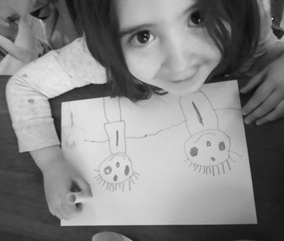
Learners are invited to use the arts to recreate any aspect of language learning the class is working on at the moment. The teacher may suggest any specific visual art or performing art for the learners to use or leave the decision to each learner. The choice might depend on the age, previous knowledge and skills of the learners.

Research tasks

This is a good moment to ask the learners questions that will make them think about the people or things they have in their personal context and just take for granted. They can, for example, do some research about past and present and interview grandparents or even great grandparents. Some may want to find out how things work. This is an excellent opportunity to ask the learner to choose any household appliance or piece of furniture and try to find out how they are built and how they work. Alternatively, learners can also do some research into why and how things are done. They may be invited to find out, for example, how to keep the house neat and clean. The teacher could invite them not only to get the appropriate process but also to explain why each step should be done in a certain way and which tools and resources are needed. A good question would be then, if they can suggest a different and most effective way of carrying out that chore.

What to remember

This new teaching situation is really stressful and demanding. Teachers feel we don’t have the skills, the tools and the resources to deliver the lessons properly and professionally the way we are used to in our face-to-face lessons. It is good to know that we are doing fine. My piece of advice to my colleagues worldwide is to relax. Giving the children our attention, love and the best teaching we can is always supportive and inspirational. If we do our best we will surely achieve great results while getting used to the new teaching context. I believe we should feel really proud that we managed to make the transition from regular to emergency remote teaching so successful. We do not only teach language; by embracing new ways of teaching we also show then how to adapt to a new situation, be resilient and face new challenges with a positive mind.


About Cecilia

Cecilia Cabrera Martirena has been an EFL teacher for more than 30 years. She has worked with all ages from Very Young Learners to Adults. Among other, she has been a Teacher Educator at two different State Teacher Education Institutes, International House, Montevideo. She is a Cambridge Tutor for CETYL and she has also been accredited Programme Leader by Cambridge Assessment International Education, for the Cambridge Educational Leadership Professional Development Qualification programme. She has been conducting CPD workshops in the UK, Brazil, Argentina and Uruguay for  the last 10 years. At the moment, she is preparing her Dissertation for MA in Professional Development for Language Education.


Contribute to the blog

If you are a member of IATEFL and would like to contribute to the blog, we’d love to hear from you at [email protected] or [email protected]. We’re looking for stories from our members, news about projects you’ve been involved in, and anything else you think those connected to English language teaching would be interested in reading. We look forward to hearing from you! If you’re not a member, why not join us?
See VIEWS Guidelines and Ideas

‘Letting life happen’ by Claudia Molnár

I’m not really one for making New Year’s resolutions, but in December I decided that I needed a year off. A totally unrealistic desire, so, I set about thinking exactly what it was I needed a year off from. After much deliberation and meditation, I realised that my life is always so well organised: a weekly timetable of classes, two daily routines, one for weekdays, one for weekends. My diary is colour coded with the various events set up for the months ahead and oh how my Mother wishes my personal and home life were as well organised.

What I needed a break from was planning. Over the years, planning had become my mantra: “I’m not going to work on Sundays”, “I’m going to go to the gym three times a week”. My greatest mantra was “work got in the way” or “life got in the way”, but then I realised life didn’t get in the way at all, because I was fitting my life around all of my very well planned out professional activities. There it was, the lightbulb moment, that bulb shone so brightly it almost exploded! I have to stop planning in order to make room for my life!

So, how was I supposed to do this? Even the thought of it was turning my hair grey. “What if I start saying no to stuff?” Well, that is exactly what I needed to start doing. Don’t get me wrong, I consider myself extremely fortunate to have the work I do-it has always been and continues to be the love of my life and I have the same passion and energy for it as I did when I started out. I would just like to have the same energy to enjoy my life as well. Did I also mention that I am equally grateful for the wonderful people I have around me, especially my friends? They are the ones who keep me sane and also the ones I feel I have to let down the most, at times. In fact, just before I started writing this, I cancelled a day out with the girls due to last minute deadlines (yes I have slipped back into my old ways at times but tomorrow is another day). One of these special people, in response to some of my plan related questions, often states that she doesn’t plan that far in advance, and I realised I needed to adopt the same approach.

I started small; saying no to the things I knew I would be doing to ultimately please someone else, with little satisfaction or reward for myself. It was initially hard to deal with people’s obvious disappointment but I soon got used to it and started to feel more relaxed. I then moved onto the financially rewarding possibilities and started asking myself whether the money I would make for that particular job, against the investment of time and effort, was worth it. Basically “Do I really need the money?” Of course, there were other considerations to take into account such as whether it was a good business contact etc. but you get my drift. I said no to private students, little one- off jobs I knew I could recommend someone else to do and slowly I began to feel more empowered.

I also became selective about who I allocated my free time to, often waiting a few hours or a day before committing myself to something, to see whether I really wanted to or not. This might sound strange but I soon realised how often I just agreed to meet someone or answered the phone to someone I didn’t really want to talk to, while ignoring that sinking feeling in the pit of my stomach. I basically started listening to my intuition-my emotionally honest self.

Just as I was getting used to it all, we went into lockdown. This brought an increase in workloads for many but I was determined not to let it get in the way of ‘my year’. In many ways it was a blessing in disguise as it obviously took a LOT of planning out of the equation. I then turned my full attention onto myself. I remained systematic in my approach to my teaching (I don’t think I need to change this) but I made sure I had my coffee in bed at least 3 mornings a week (I’d love a three-day weekend, wouldn’t you?) and I made sure I closed my laptop at 6 pm at the latest and always took the weekend off. What didn’t fit into a working day was an unrealistic expectation by the one who had imposed it.

I fell in love with listening to the radio, I mean, really listening, not just having it on in the background, BBC Radio 2, 6 Music and FM4 are a few of my passions; I often felt my eyes were almost bleeding from the screen time and I couldn’t cope with looking at anything. As teaching petered off (I’m a university lecturer so our semesters are shorter than for schools) I fell back in love with reading. I never fell out of it but I could never devote proper time to it as it was often hard to get into a story when you only manage a page or two a night. This means I have often gone to bed to read very close to the end of my working day. My bed is my sanctuary so, yes I have been in bed by 6.30 on days I haven’t had to cook.

I created a permanent yoga space and practise regularly (I did, at times plan to do it every day, of course, but they were ‘old ways’ days ).

It’s still a work in progress but I have learnt to let go of so much small stuff and not to beat myself up when something doesn’t go accordingly. Primarily, I have finally found a healthy work life balance, I intend on keeping to in the future. I remain honest to myself and love letting life just happen. Why not give it a try?


About Claudia

Claudia Molnár has been teaching EFL/ESOL for over 20 years and she holds a CELTA, DELTA, PGCE and a Master’s in Education ( TESOL). She is a PHD candidate in Multilingualism through Instruction with the main area of her research being developing confidence and learner autonomy in a teacher training context. She is the current President of IATEFL Hungary.

Since moving to Hungary from London, Claudia Molnár spent five years teaching in a secondary grammar school and she is currently the head of English Language Pedagogy at the English and American studies Institute of the University of Pannonia in Veszprém. She also works freelance as an ELT trainer and author.


Contribute to the blog

If you are a member of IATEFL and would like to contribute to the blog, we’d love to hear from you at [email protected] or [email protected]. We’re looking for stories from our members, news about projects you’ve been involved in, and anything else you think those connected to English language teaching would be interested in reading. We look forward to hearing from you! If you’re not a member, why not join us?
See VIEWS Guidelines and Ideas

‘ELT Footprint: a personal reflection’ by Katherine Bilsborough

The most surprising thing about ELT Footprint is that it didn’t already exist. There wasn’t a go to place for those of us keen to discuss the relationship between our profession and the climate crisis, to find engaging classroom materials for our students that went beyond the typical environment unit in the course book or to share ideas that might lead to real change. With the creation of ELT Footprint – first the Facebook group, then the blog, website, Twitter and LinkedIn – all that changed. Below are five examples (in no particular order) of ways in which ELT Footprint has made me a better professional and perhaps even a better person.

1. A broader outlook and a touch of humility

ELT Footprint is a community with more than 3,000 members from all over the world. Coming from the UK and spending most of my professional life in Spain, I’ve had very few insights into the experience of my peers in different parts of the world. In the Facebook group when someone shares a poster about recycling, for example, someone else promptly reminds members that recycling isn’t a problem where they live because they have nothing to recycle. I’m convinced that by tackling issues of greed and an excess of consumerism, teachers can make the world a fairer place. Hearing about hardships and innovative solutions to a lack of resources is inspiring and I welcome the constant reminders of inequalities and injustices. Without them we are in danger of burying our heads in the sand.   

2. An increasingly rigorous attitude to news

Many people like to share shocking statistics in an attempt to shake us up and get us thinking about what we need to do to make changes  we so desperately need. In terms of the climate emergency there is no shortage of graphs and charts informing us of how we are destroying our planet. But often when this data is shared in the ELT Footprint community, someone points out a flaw in the findings or a bias in the reporting, prompting members to look for evidence to back up claims or dismiss something as unscientific. We can’t be over-rigorous. Now, more than ever everyone needs to fact check until it becomes second nature. And as educators we need to teach our students how to evaluate information, to ask questions and to check the validity of pretty much everything that is presented as fact.

3. Bringing issues into the classroom

Everything shared in the community should ultimately come back to the heart of our purpose: students, teachers and the classroom. In our enthusiasm and thirst for knowledge the group has shared more than 2,000 posts and links in the past twelve months. I see one of my roles as asking (and sometimes answering) ‘How could these be used in a classroom?’ It’s exciting to see how a single photograph or a short news article can be a springboard for lesson ideas in a dozen different contexts. The best part is when teachers try some of these ideas out with their students and report back to the group to share the outcomes. Teachers are well placed to craft materials for their own classrooms because nobody has a better understanding of their students’ context, needs and preferences.

4. Collaborating and cooperating

Educators often talk about the importance of collaboration and cooperation and we try to encourage it in our students. For many teachers, they are two of the fundamental ‘c’ words. But we don’t always practise what we preach so I always find it heartening to see teachers and materials writers work on joint projects. This happens a lot in the ELT Footprint community when people living on opposite sides of the world discover they are teaching in similar contexts or have shared interests and decide to take an idea from a chat one step further and do something magic, like create a set of free resources to be shared with colleagues.

5. There is no Planet B

Ultimately, the success or failure of any group is dependent upon the people who belong to it. A shared passion for our amazing planet is one thing we all share, no matter what differences we might have in other areas of our work and experience.  For a large section of the community, the climate emergency is the most important issue right now. We do care about other issues of course. Many inequalities and injustices are inextricably linked to some of the causes of the environmental crisis. But as somebody wise has said, ‘There is no Planet B’. We all have a moral obligation to do what we can to stop harming the planet and to do everything in our power to repair what we can. Through ELT Footprint I’ve learned that there are lots of ways that educators can do this. We can share ideas of how to reduce our individual carbon footprint but we can also make a big impact by going one step further and taking action in schools, Teaching Organisations, Publishers, Ministries of Education and anywhere else where we happen to meet en masse. And as we figure out new, greener ways of teaching and working, belonging to a group like this will, I believe, give us a place to find the support and encouragement we require to first figure out what changes we need to make and then to implement them.  

Everyone is welcome to join the ELT Footprint community. Find us on Facebook, explore our website (especially the blog), follow us on Twitter or/and hook up on LinkedIn.

Website: https://eltfootprint.org

Facebook: https://www.facebook.com/groups/eltfootprint/

LinkedIn: https://www.linkedin.com/groups/8908518

Twitter: https://twitter.com/ELTfootprint


About Katherine Bilsborough

Katherine Bilsborough has worked in ELT for more than 30 years, as a teacher, trainer and author. She has published books with several key ELT publishers and writes blog posts and lesson plans for the British Council’s Teaching English website and National Geographic Learning’s In focus’ blog. Katherine is on the committee of IATEFL’s MaWSIG (Materials Writers Special Interest Group) and is a co-founder of the ELT Footprint community. 



Contribute to the blog

If you are a member of IATEFL and would like to contribute to the blog, we’d love to hear from you at [email protected] or [email protected]. We’re looking for stories from our members, news about projects you’ve been involved in, and anything else you think those connected to English language teaching would be interested in reading. We look forward to hearing from you! If you’re not a member, why not join us?

See VIEWS Guidelines and Ideas


‘Zooming in on Digital Education’ by J. Mangayarkarasi

The Covid-19 virus has had a tremendous impact on all educational institutions in the world, and India is no exception. When PM Modi declared total lockdown with only 4 hours’ notice in the evening of 24 March, no one was prepared, especially not educational institutions. Total lockdown forced the suspension of concrete classrooms, which was a shock. It took a day or two to realise that we needed to move to virtual classes, but then it made us create virtual learning infrastructure in our institution and transform the way education was offered up to that point.

Lockdown – Phase One

I started exploring the availability of online teaching and learning pedagogy in ELT on Google Meet, Zoom, and so on and delivering my lectures through these platforms. This way academic activities in our school were much less affected by the lockdown than they could have been.

Lockdown – Phase Two

On 10 April the Government launched a campaign called “Bharat Padhe Online”, designed to promote online platforms for teaching and learning. It was a blessing for institutions like my school. A ‘Digital Glass Room’ initiative was made available by the school management to engage ESL learners by sharing interactive resources such as lessons, videos, worksheets, assignments, puzzles, debates and so on. Assessment and feedback strategies were also available to enhance and encourage the learners’ participation in Google classrooms.  These spontaneous developments provided better learning experiences.

Lockdown – Phase Three

I started exploiting and integrating web tools through ELTAI, our English language teachers’ association, to teach English to ESL learners. As I understood these tools create a learner-centred atmosphere because they allow learners to create something new out of their own knowledge rather than be passive recipients of classroom lectures. The web tools used in teaching online in our school were Edmodo and Projeqt. They both make it possible for teachers and learners to connect and assimilate into a social network.

Through Edmodo, teachers can create online groups to provide resources for learning and administer the learning process and outcome, while Projeqt allows the creation of multimedia presentations, interactive maps, interactive quizzes and videos which can be used for presentations at various levels. These web tools can provide opportunities to enrich the language learning environment and create a visual impact that motivates shy and slow learners to open up with their creativity. They also encourage them to engage in their online English classes in an effective way and makes the learning experience fun. 

Lockdown – Phase Four

Webinars, online interactions and workshops on online tools for teaching English were offered freely by the British Council, RELO, ELTAI and OUP. As a follow up to my online training I decided that some investment in the infrastructure and additional training for the school and learners was required, so I made digital transition in two ways. I first used recorded classes via live online platforms such as webinars or zoom sessions. For this high-speed internet was required, as well as members of staff who were already comfortable with teaching online. Learners also needed computers/mobiles to attend the classes.

Lockdown – Phase Five

The quarantine period made me active, and within a few days I gained confidence through thousands of followers on social media platforms. I am already planning to move live lessons to YouTube soon The webinar sessions energise myself, my teaching, lesson planning resources and methods

It is really amazing to have a vibrant series of lectures, interactive sessions and presentations by students rather than being trapped within four walls with text books a single teaching tool. I am lucky to reach larger groups with varied backgrounds through live sessions, and this is why my ESL learners enjoy and appreciate their new learning environment. 

Lockdown – Phase Six

The only accessible media for underprivileged learners in India are Television, Radio and Podcasts. It is a blessing that those who do not have access to the internet can learn through television educational programmes.  This mode of education provides an opportunity to design common syllabus and teach essential English language skills that can be devised to reach out to different levels of learners. For teaching the ESL learners we have been having educational networks through TV, educational programs that have been converted through educational channels. After the outbreak of the pandemic India also broadcast educational ESL programmes on television.

Post lockdown

I am looking forward to bringing challenging topics and online courses to learners in an easily accessible mode. I would like to inspire learners to integrate artificial intelligence and augmented reality into their educational lives by using smart content by continuing personalized learning.

In conclusion, let us together fight our inhibitions, embrace the change and make way for our new future!


About J. Mangayarkarasi

Mangayarkarasi . J.  is Associate Professor and Head of a PG and Research Department of English at Ethiraj College for Women, India and Coordinator of English Language Teachers Association of India, an associate of IATEFL. She has published 3 books for language teachers including the course cum work book on language resource centre and ESL Methods and Practices:  An assessment of syllabus in her state. She is currently interested in bringing artificial intelligence and augmented reality into ELT.Recently she has been recognised as one of the Top 50 Women Educators across India by a news organisation.


Contribute to the blog

If you are a member of IATEFL and would like to contribute to the blog, we’d love to hear from you at [email protected] or [email protected]. We’re looking for stories from our members, news about projects you’ve been involved in, and anything else you think those connected to English language teaching would be interested in reading. We look forward to hearing from you! If you’re not a member, why not join us?

See VIEWS Guidelines and Ideas

‘Shining under lockdown with the Hands Up Project’ by Rida Thabet

No one could have ever imagined that the whole world might undergo such a dramatic change that is likely to reshape our perspectives on almost everything in such a short space of time! For the first time in history, the whole world is facing the same challenge. We seem to be fighting the same invisible enemy which doesn’t recognise borders and doesn’t flatter the elite. In the past, wars or famine chased poor underprivileged people away from their homes while better off folk went on with their lives. I wonder if this new virus has come to teach humanity lessons in fairness, justice and equality? It has certainly managed to crawl into the bodies of the homeless as well as to infect the otherwise untouchable and privileged people such as royals, politicians and military leaders. It has already ended many lives and forced the rest of us to be locked down in our houses and palaces. Theories, values, and attitudes are currently being re-evaluated. ‘Social distancing’ has become the slogan of the day, and the best you can do to save humanity has turned out to be to comply with the order to ‘stay at home’.

The 5th of March started as a typical day in Gaza but turned out to be quite different at its end. Preparations for our 4th PATEFL conference on creativity were well underway and we were busy putting together the final touches. Out of the blue, firm restrictions were imposed to stop the spread of the COVID-19 virus. Accordingly, all events had to be cancelled, and people were required to stay at home. Everything was suspended as if life on earth needed a desperate break!

With schools closed, the online sessions organised by the Hands Up Project (HUP) had to stop as well. At the time, there were hundreds of students involved in online drama sessions and remote theatre activities run by a large network of volunteers from all over the world. These virtual sessions were conducted in schools in Gaza by local teachers and volunteers from around the world. They used to make a huge difference to the lives of students and to their learning. In addition to the above, these online activities included storytelling sessions, and other speaking activities like ‘show and tell’ done jointly with students in different countries. As well as developing their English skills, these activities provided young people with a voice in the wider world.

To be forced to ‘stay at home’ seems like a punishment, and ‘social distancing’ has negative connotations such as boredom, idleness and loneliness. However, in Gaza, we are used to ‘staying at home’ and being ‘socially distanced’! Thus, in many ways, we were perhaps better placed than many other contexts to deal with the situation suddenly imposed on us. Through the Hands Up Project’s innovative work here, we already had an infrastructure in place to work very successfully with remote learning. In fact, teachers and learners here are very experienced in interacting through videoconferencing tools like Zoom for the simple reason that, for many years, this has been the only way that the vast majority of people were able to have any form of communication with the outside world. By the same token, Palestinian English teachers are very familiar with collaborative online projects with other English teachers around the world (see Sahar Salha’s piece in the 2019 IATEFL Conference Selections: ‘Enhancing teacher performance through online team teaching’) and this has also stood us in good stead for what was to follow.

Two days after the ‘lockdown’, we were able, through minor adjustments, to continue learning through the existing large HUP network that connects volunteer teachers with thousands of (now quarantined) people all over the world. Children and adults now ’meet’, sometimes twice a day, to listen and interact with stories from different origins and cultures. It’s a growing community which started with international volunteer storytellers working with classes in Palestine and has now expanded to reach much larger audiences all over the world.
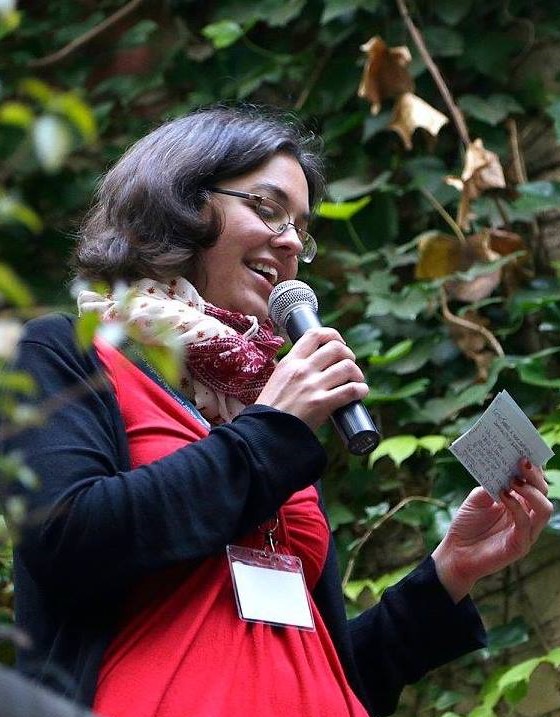
HUP Facebook live storytelling time has become an event to look forward to during the long days of quarantine. Once a storyteller goes live, viewers start to join as if they are part of a live audience sitting in a circle to watch a Japanese kamishibai or an Arab hakawati. New ways of approaching an audience are now emerging and they are doing an amazing job. I think this is a new phenomenon that should be studied; and its impact on learning researched. You can have a look at the stories and feel the power of interaction in the comments and the follow up videos students upload in response of the sessions at: https://www.facebook.com/handsupproject/videos/

In addition to the storytelling sessions, students, teachers and parents ‘meet’ virtually to watch curriculum-based content presented by ELT experts twice a day; thereby developing their skills and knowledge through live Facebook sessions. Members of the virtual audience interact, ask and answer questions, make predictions, comment on the atmosphere with enthusiasm and a passion for learning and interacting with people from all over the world.

All this has happened in just few weeks because we had a solid foundation on which to build, and more is yet to come! It has all been achieved with the determination, adaptability, and perseverance of the Hands Up Project global family. This also shows how we can be resilient and cope with challenges. Unless our education systems follow such examples, many children will fall behind in terms of their education.

Hats off to the Hands Up Project, to its founder Nick Bilbrough and to all the HUP team and volunteers around the world! What has been achieved in this very short time is a shining example for ‘education in emergencies’ for the entire world to see; a unique way to reach learners at home.


About Rida

Rida Thabet is an educational specialist working at UN Relief & Works Agency in Gaza, Palestine. She is a core skills trainer and one of the British Council school ambassadors. She is one of the Advisory Board members of HUP and a member of Palestinian Association for Teachers of EFL (PATEFL).


Contribute to the blog

If you are a member of IATEFL and would like to contribute to the blog, we’d love to hear from you at [email protected] or [email protected]. We’re looking for stories from our members, news about projects you’ve been involved in, and anything else you think those connected to English language teaching would be interested in reading. We look forward to hearing from you! If you’re not a member, why not join us?

See VIEWS Guidelines and Ideas

‘A Post-Corona SWOT Analysis’ by Sandy Millin

Coronavirus COVID-19 will probably impact how we live our lives for many years to come. But what might that mean for the future of English language teaching?

SWOT stands for Strengths, Weaknesses, Opportunities and Threats, and is often used by businesses for strategic planning. This article from MindTools tells you how to do one.

N.B. I work in private language schools, so some of the ideas here may apply only to that branch of English language teaching. Please add your ideas to the comments.

Strengths

Working online has long been discussed in ELT. We have many experts knowledgeable about teaching online, including how to put together successful long-term online and blended projects. They can help us to develop our teaching and course offers, and to work out how to be more resilient in the face of possible future pandemics.

Live online teaching through platforms such as Zoom puts teachers and students (or trainers and trainees) on a more equal footing: it’s harder for one person to physically dominate the classroom when your videos are the same size. This could encourage greater sharing of ideas and help students/trainees to feel more involved in their learning.

Teachers around the world, not just in ELT, have proven that there is a huge determination that education will continue, regardless of the limitations put upon us by, for example, the current virus situation. This desire to experiment and try out new things, and to reflect on what does or doesn’t work, is a great opportunity for all of us to learn from each other.

Weaknesses

While we are forced to try new things, we also try to recreate physical classrooms in an online space but get frustrated when we meet limitations. It’s important to realise that online teaching creates new demands on teachers, and thus requires new types of support from managers and trainers.

Access to appropriate resources for teaching and studying online varies greatly, including access to the Internet. If all members of your family are working and studying in the same space, how can they concentrate? If there is only one laptop, who is allowed to use it? And if there no access to the internet, what other options are there for students? Can schools provide the technology and internet access teachers and students need? Even where they can, are they willing to do so?

Finally, and most importantly, the lack of prior ‘crisis planning’ and relevant training has created an incredibly stressful situation for many teachers and schools. The current situation has highlighted the precarity of private language schools with many having to lay off teachers, often with no warning or promise of further support. The lack of previous training in how to use online technologies meant a steep learning curve. The ongoing risks to our long-term mental and physical health are exacerbated as we deal with stress caused by having to adapt quickly, feeling that we must continue for our students’ sake despite the physical demands of increased screen time on our eyes and bodies.

Opportunities

However, there are some positive aspects to this new situation; ones I hope continue after Coronavirus. For example, it’s easier than ever to invite guests into our classrooms (with appropriate safeguarding measures). We can connect classes up remotely, as people in lockdown or quarantine seek new forms of social contact. What better way is there to give students a real purpose for speaking English than communicating with classroom visitors? Online teaching also provides an opportunity for students in different countries to form friendships that will hopefully endure.

Since moving online, I’ve seen all kinds of new ideas for teaching, training and socialising – necessity really is the mother of invention. In particular, organisations have started regular training sessions or meetings via Zoom; opening up discussions and sharing in ways I have never experienced when training online. This may have existed before, but it seems much more common and accessible now.

Many teachers and students have found that online lessons are not as bad, or as difficult, as feared, which opens up new opportunities for future teaching. Schools that were previously only bricks-and-mortar will be able to broaden their businesses, and teachers will have more freedom to teach in a variety of new ways.

Threats

The move to teaching online happened abruptly and, for most of us, with minimal planning. Many of us rushed to use the first technology we came across in order to get through the crisis, without carefully considering the implications of choosing and using that tool. Technology providers have been put under a lot of strain very quickly. Security flaws have been publicised, and these concerns (rightly) won’t go away in a hurry. We ask teachers and students to share their data, without necessarily being clear about how this affects their privacy. This may continue to push power towards large organisations, and/or mean that teachers and students avoid online lessons as security and privacy concerns become clearer.

Safeguarding and inclusion have also been difficult to consider in the rush to move online. Safeguarding is our ability to provide physically and mentally safe environments for teachers and students, as well as maintaining this safety over time. We need to minimize the risk of potentially dangerous or stressful experiences online. Inclusion is ensuring everyone can access lessons we are providing. On a logistical level, this is the availability of technology and tools, the strength of internet connections, the technical knowledge and awareness of teachers, students and parents, and whether the environment at home is conducive to motivated study or focussed work. Inclusion also means accessibility for students with a range of needs, for example, dyslexia, autism, and visual or hearing impairments. If we don’t consider safeguarding and inclusion as part of our online provision, we risk alienating students and teachers, excluding them from areas of education, and even of longer-term damage to their wellbeing.

Most worryingly, the global recession that is bound to come means non-essential spending will be reduced. For many companies/businesses, this may be English lessons; meaning there will probably be fewer students to go around. Teachers may lose hours, or more highly-paid family members may lose their jobs meaning that teachers need to find better-paid work. The future of the private language school industry and its employees is more uncertain than ever.

Conclusion

I don’t want to finish on a negative note though. What this crisis has made eminently clear to me is just how supportive we are as a community of teachers. I have a lot of hope for the future. We have an opportunity to rethink so many areas of our lives, and how we deliver English language teaching and training is no exception. I hope that this initial SWOT analysis has given you some ideas. What would you add?


About Sandy

Sandy Millin is the Director of Studies at International House Bydgoszcz in Poland, and the former curator of the IATEFL blog. She is also a CELTA trainer and materials writer. She has self-published three books: Richer Speaking, ELT Playbook 1 and ELT Playbook Teacher Training. She blogs regularly at http://sandymillin.wordpress.com and tweets @sandymillin.


Contribute to the blog

If you are a member of IATEFL and would like to contribute to the blog, we’d love to hear from you at [email protected] or [email protected]. We’re looking for stories from our members, news about projects you’ve been involved in, and anything else you think those connected to English language teaching would be interested in reading. We look forward to hearing from you! If you’re not a member, why not join us?

See VIEWS Guidelines and Ideas

Lockdown Downunder: some snapshots (and online lesson ideas!) from New Zealand

Blog article by Jill Hadfield

Situation at the time of writing

We are currently in Week Seven of Lockdown. The government adopted a policy of ‘Go Early, Go Hard’ and ‘Test! Test! Test’! This means that at Level 4 only ‘essential services’ were open. No flights except to repatriate people. All repatriated Kiwis are quarantined in hotels for 14 days. No driving at all, except for food, pharmacy, or doctor. One could go out for exercise, but that’s all. We are now at Level 3- basically the same but a few more  services open. We are waiting to hear if we will go down to Level 2 next week. There have been 21 deaths so far; mostly infirm residents in a care home. The latest stats: between 0-2 new cases a day, around 1400 cases in total, 92% recovered with 2 in hospital.

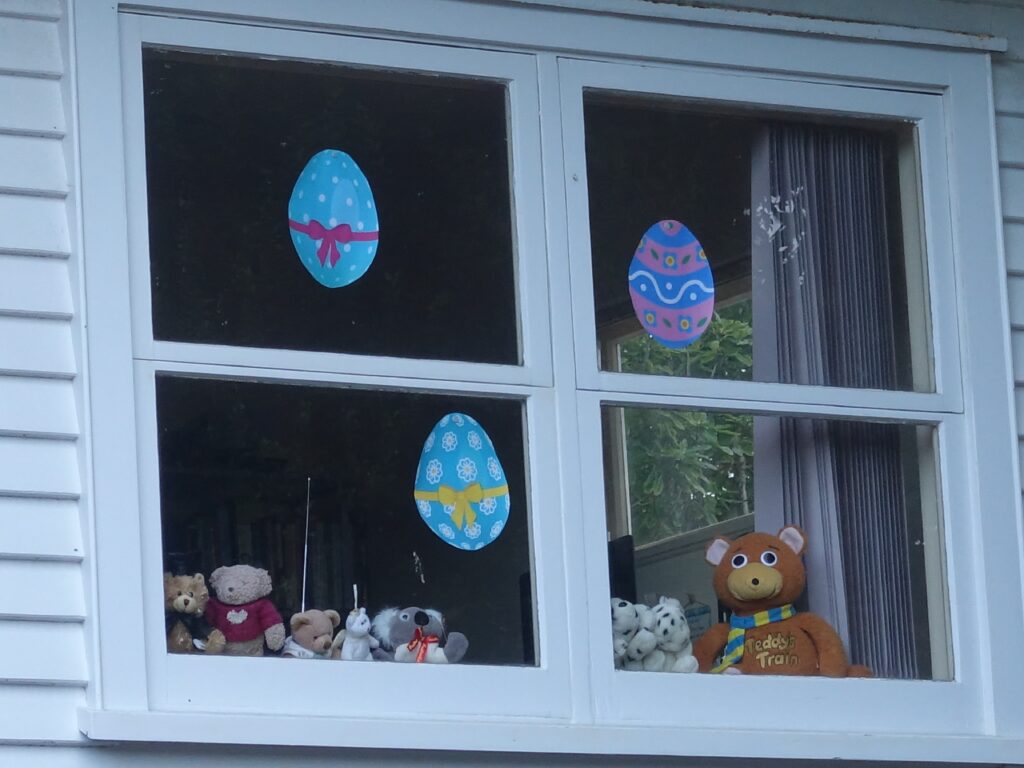
We are so grateful for our Prime Minster Jacinda Ardern’s mix of resolve and compassion, as well as her good sense and down to earth honest humanity. She gave her first national briefing in a tracksuit from home. She apologised to the nation for her informal attire but explained that she had just been putting their toddler, Neve, to bed “….and, as you parents will know, it can be a messy business”. She suggested putting coloured paper eggs in our windows, so that children out for a walk with their parents could have an Easter egg hunt. Here are ours: 

Some Vignettes of Lockdown Downunder

Before the Easter Egg Hunt, people had been putting Teddy Bears (or, in NZ English, “Tiddy Beers”) in their windows so that children could go on a Bear Hunt. Remember that wonderful book by Michael Rosen – “We’re Going On A Bear Hunt”? Here’s the author performing it – lovely video to share with children if you are teaching online. Get your students to do the actions!


Yesterday, a Lufthansa A380 jet with the last batch of 500 German nationals departed Auckland. It flew over our house and then did a big loop around the city centre to see the Sky Tower illuminated with the colours of the German flag.

Our daughter is a primary teacher, living across town with three teacher flatmates. They are all teaching online, working at different schools, and have been very supportive of each other with lesson planning, movie nights, a book club et al. I cannot imagine the organisational skills involved in teaching twenty 8-year olds by Zoom!  Here’s a nice idea she shared with us that you might like to try if you are teaching online. She asked the kids to go outside, sit quietly and to focus on their senses: what could they hear/see/smell/feel. Then they came back and shared impressions, and she gave them a framework to make a poem. A great idea for getting children away from the screen, and into the ‘real’ world!

The Student Volunteer Army (who did a wonderful job in Christchurch clearing up after the earthquakes there) are now doing shopping for the over 65s. The Sikh community are also doing this.  We appreciate the sense of community in NZ, the “can do” attitude, as well as the sense of humour! For example, the NZ Police have made some funny videos with advice on distancing: a fun song, ‘Two metres please”, and a translation guide to ‘teen speak’ for parents stuck at home with teenagers:


These fun videos could be used in lessons as listening comprehension, or even as a source for creative writing – for example, to write another verse for the song, or to write a parent-teenager dialogue.

Stop press!

Jacinda Ardern, our Prime Minister, has just announced that she, as well as all the ministers, are all going to take a 20% pay cut!

Positives arising from the Lockdown  

Staying in touch with family, friends and colleagues across the globe via social media, such as email, skype, zoom, facetime and even… old fashioned ‘telephone’! At one of these virtual meetings, we all showed an unusual object and the others had to guess what it was. Then the owner revealed the story behind it. Objects shared included a sextant, a Tibetan amulet and a porcupine fish float bladder! Again, a nice idea for an online teaching session: get your students to show an object, and the others can guess what it is, when or how they obtained it, or the story behind it!

Charlie’s choir concert, St Matthew Passion, was due this week; cancelled now, obviously, but the choir still meet for virtual sing-alongs. Charlie dressed up for one recording in the choir ‘uniform’ of black shirt and tie, but below waist he wore shorts and sandals!  After the recording, he came out to join me on the deck for a shouted conversation with neighbours and had to explain why he was dressed so oddly! The neighbours then demanded a performance; so, he sang the chorale and the whole street applauded!

What I think is keeping us sane, apart from all of the above, is trying to do something creative every day. I mean creative with a small ‘c’ – not works of art! Currently, we are trying our hands at a limerick competition – try to summarize a Shakespeare play in a limerick. Here’s one. Can you guess the play? And another one about the same play that somehow ended up being rather more about the NZ accent than the play:

When it looks like the marriage won’t mend
she gets the wife to pretend
that she’s dead
enough said
‘cos it works out fine in the end.

“Ixit pursued by a beer”
is a line you don’t often hear
But one time we did
Performed in In Zid
where Kiwis pronounce /eə/ as /ɪə/.

Creativity can give you a real boost! Try it! As a variation, ask students to summarize a book/film in a haiku. Can you guess these:

Precious ring is lost
Small men with hairy feet
Try to find it.

Orphan boy
Buys a broomstick and an owl
Defeats evil lord.

Old lady tells story
Of love, ships and icebergs
Lover dies, she survives.

This can make a nice lesson if you are teaching online! Get students to post a haiku and to guess the source of others’ haikus!

Finally, it’s been great to share something of our lives here ‘downunder’ and feel a sense of connection with you all in these strange times. Stay safe and keep cheerful! Noho ora mai!

Jill Hadfield (NZ)


About Jill

Jill Hadfield has worked in France, China, Tibet and Madagascar and  was until this year Associate Professor in Language Teacher Education, Unitec, New Zealand. She is currently working freelance, writing and editing ELT materials.  She  has published over 30 books for language teachers including the Communication Games series, Classroom Dynamics, Introduction to Language Teaching  and Motivating Learning. She has also written two travel books and a novel.  She is currently interested in bringing research into practice through the Research and Resources in Language Teaching series, creativity in language teaching and online interaction.  Her latest book Interaction Online, with Lindsay Clandfield (CUP)  was shortlisted for the Ben Warren Prize  and the ELTons Award for Innovation in Teacher Resources.

Contribute to the blog

If you are a member of IATEFL and would like to contribute to the blog, we’d love to hear from you at [email protected] or [email protected]. We’re looking for stories from our members, news about projects you’ve been involved in, and anything else you think those connected to English language teaching would be interested in reading. We look forward to hearing from you! If you’re not a member, why not join us?

See VIEWS Guidelines and Ideas

The remarkable resilience and creativity of ELT teachers

There’s a lot of negativity around at the moment, both in the world and in ELT. When the IATEFL conference in Manchester was postponed to next year, it really hit me how much it means to me. I could write this whole post about how our annual get-together has been fundamental to my career, but suffice it to say that the void it leaves in my year was felt very keenly when I realised that it wouldn’t be happening in 2020. The same can also be said for the BRAZ-TESOL conference that was due to take place in São Paulo but has also been put back to next year. Moreover, there are all the local events that won’t be happening; and then you start to get a sense of how just this one aspect of what we do, as a community of practitioners, has gone in an instant.

And if we widen the scope out from conferences, you can see how the entire ELT sector has been transformed in a matter of weeks. Whatever sector you work in, wherever you are in the world, the work that you do has more than likely been utterly changed. The most obvious example is in the classroom, which has moved from being a physical space to an online environment with a speed that none of us could have imagined. 

However, what I have also observed has inspired me, and should prove to all of us that ELT professionals can withstand this unprecedented situation. Teachers across the world have been asked to completely change the way they teach in a heartbeat. With little training and time, they have responded remarkably driven by a determination to keep educating their learners. Teachers who have never taught online have embraced the challenge and adapted with incredible speed.

I think we need to acknowledge what is really happening now. This is not normal ‘online teaching’, which is an area with a great deal of research and scholarship. Courses designed specifically for an online environment are planned over months and even years. Teachers are trained and given time to get used to the new technologies in order to maximise the tools they have to deliver quality courses. Support systems are put in place for both learners and teachers to ensure effective teaching and learning.

What has just happened to us is quite different. The training has been, at best, minimal, and the support systems have been thrown together at the last, if not after the last, minute. Syllabuses haven’t been designed but adapted from the face-to-face versions; as have the lessons. This isn’t a criticism. It is a completely pragmatic and understandable response to an emergency. 

With this in mind, I think it’s useful to term what teachers are doing now as ‘Emergency Remote Teaching’ (ERT) as opposed to ‘Online Education’. This new term is being used to describe the current situation, and I believe its value lies in the fact that it enables us to get a better understanding of what is required. By realising that “the primary objective in these circumstances is not to re-create a robust educational ecosystem but rather to provide temporary access to instruction and instructional supports in a manner that is quick to set up and is reliably available during an emergency or crisis” (Hodges et al, 2020), we can realistically appreciate what teachers and learners are able to achieve. 

A crucial aspect of ERT is creativity. Teachers have to be quick on their feet and be able to respond to unpredictability in unfamiliar environments. New solutions need to be found in settings where teachers need to balance the limitations of an online classroom and the vast and overwhelming amount of resources available on the Internet.

What has been clear in the last few weeks is that this creativity is not in short supply. It has been remarkable to see how teachers the world over have responded by creating and sharing links, ideas and tools. Coupled with a sense of community and collaboration, teachers have taken what is undoubtedly a terrible situation and addressed it with resilience, camaraderie and collaboration. This should make all of us in ELT feel proud and hopeful.

Unfortunately, it is very likely, especially if we work for private companies or freelance, that our market, like all others, will contract in the next few years. If we work in public education, we will probably find resources even more difficult to come by. Of course, we need to be mindful of this, and prepare ourselves for this new world. We also have no idea what further impact the COVID-19 pandemic will have on how we work in the future. It is entirely possible that for some of us this switch to online teaching is here to stay, and will not be reversed. But I’m not overly concerned about how our profession will react because, based on what we have witnessed in the last few weeks, the creativity and resilience I have seen on the part of ELT colleagues have demonstrated what remarkable and resourceful people teachers truly are.

Thanks to my colleague Claire Venables for introducing me to the concept of Emergency Remote Teaching.

References:

  • Hodges, C., Moore, S., Lockee, B., Trust, T., & Bond, A. (2020). The Difference Between Emergency Remote Teaching and Online Learning | EDUCAUSE. https://er.educause.edu/articles/2020/3/the-difference-between-emergency-remote-teaching-and-online-learning


About James

James M Taylor is an EFL teacher, teacher trainer, & materials writer based in Brasília. He produces the ELTON nominated TEFL Commute podcast. In 2018 he and Ilá Coimbra created the Raise Up! Project, encouraging diversity in ELT materials. He has recently co-written ‘Our Languages’ for FTD Educaçao. He’s a committee member of BRAZ-TESOL Brasília & IATEFL TDSIG.


Contribute to the blog

If you are a member of IATEFL and would like to contribute to the blog, we’d love to hear from you at [email protected] or [email protected]. We’re looking for stories from our members, news about projects you’ve been involved in, and anything else you think those connected to English language teaching would be interested in reading. We look forward to hearing from you! If you’re not a member, why not join us?

See VIEWS Guidelines and Ideas