‘Q & A from Chaz Pugliese’s webinar on creating motivation’ by Chaz Pugliese

On 18th March 2017, Chaz Pugliese presented the following IATEFL webinar:

Creating Motivation, Creating Learning

I believe in local research, so a few years ago I conducted interviews with over a hundred of my students in Paris, where I’m based. The main purpose of the interviews was to find out from the students what practices/activities they found motivating. It turns out these students’ motivation is boosted when they feel they’ve been accepted by the group, when they are primed for learning, and when they’re engaged in activities that are stimulating, surprising and fun.

In this webinar I will focus on the multifaceted roles of the teacher in promoting motivation, and I will highlight the importance of creative pedagogy.

Thank you to the 250+ people who attended, and those listed below who asked questions. If you would like to watch the recording, you need to be a member of IATEFL (find out how to join), but even if you’re not a member, you can read Chaz’s answers to some of the Q&A questions below.

Wouldn’t the basis of motivation be determining whether their motivation is intrinsic or extrinsic?

In truth, I don’t really care to know what kind of motivation my students may have: if it’s intrinsic or extrinsic, or if it’s both, or if they have the kind of motivation Dörnyei talks about (the ideal-self, the ought to- self, etc). My job is to provide them with an environment that might tap into that, to help them focus, to surprise them and to stimulate them beyond the language learning per se. If I do that, then whatever motivation they may have, it will be tapped into and that’s what I want in the first place.

How does motivation relate to perseverance? Surely, no learning can be done without initial intrinsic motivation, but what about helping students build grit? Any ideas on that?

There isn’t a cookbook for helping the students build grit. However, there are strategies that may lead students to develop self-esteem and perseverance. I think the way we communicate with our classes can have a very significant impact. We’re all familiar with the Pygmalion study, for example.

Think about the way we give them feedback: helping the students use their own past work (as opposed to his/her peers’) as a benchmark for progress, which is all beneficial in the long run.

How can you motivate big classrooms (e.g. 200 students or more)?

Doable: I wouldn’t change anything but obviously with 200 bodies in one room, we need great classroom management skills. We need groups, students as teaching assistants, work stations. But, granted, not easy.

How do you motivate students when they are anxious and waiting to start a class test?

Anxiety can be debilitating. So, at the start of class, it would be a good idea to do a few exercises that don’t require language use, just to make people relax. Jokes are good in this respect.

Fun plays an important role, but not all students want fun in the classroom. They stay indifferent.

Yes, it may happen. The question is: why? And there might be several reasons, some may be linked to the context, some may have to do with their past learning history.

For my part, I don’t use the word ‘game’ and I never talk about ‘fun’ with my students, either. I’ve found time and again that if I say to my class ‘OK, let’s play a game’, or ‘Let’s do something fun,’ some may conclude I’m giving them license to goof off and they lose focus. And I don’t want that to happen.

I think what might help is explaining to your classes the rationale behind an exercise that is ‘fun’. For a lot of my students here in Paris (but also in other countries where I’ve taught), learning = no pain, no gain. So that’s what they expect to do. And if their teacher does something that is more light-hearted, they’re thrown because it doesn’t fit with their mental representation of what learning is supposed to be all about. So, they remain indifferent, or worse, they become hostile.

Does it mean that the teacher should always be in the state of creating something?

Ideally, yes. But this needn’t be a daunting task, you’re not out to revolutionize the teaching field as we know it… Being creative is a frame of mind, a decision one takes. If you want to know more about this, please see my own book Being Creative (2010, Delta).

In your opinion what do you think about teachers who are not motivated, do you think they will be able to motivate their students? How? ‘Cause it seems impossible.

I don’t know about it being impossible. One thing is certain: if it’s true that we can’t motivate anyone to do anything for us, there’s so much we can do to demotivate them… Being taught by someone who doesn’t believe in what they do, who’s not feeling passionate about their job, who doesn’t want to be with us, is clearly demotivating. Have you ever been taught or can you imagine being taught by a demotivated (or amotivated) teacher? Or worse off, by a teacher who shows clear symptoms of burn-out?

Sadly, many of the teachers I work with are on the verge of burn-out, and often they don’t even realize it… This is serious and something must be done about it. My impression is that teachers just want to teach, but in reality many feel their own spark has been put out by the powers that be…Teachers need to be better paid, and rewarded for what they chose to do, which is teach and help people grow, not fill out forms and check off boxes.

How can you convince administrations that want fixed curriculums and predictable and quantifiable results that you’re not just wasting time?

Well, when we’re introducing changes, we need to tread carefully. We need to show leadership and ‘sell’ our approach right.  Sometimes we need to convince our colleagues, our students, their parents, and not just admin! But we need to welcome skepticism, criticism, even, and find a way to win them over. The bottom line is: believe in what you do, and if you know it works with your classes, if your classes appear more motivated in the long run, what’ll have happened is that the students will achieve better results.

Is listening to you and chatting at the same time like chasing two rabbits?

Yes, to an extent, even though the fact that you’re chatting about something relevant may make it easier. My guess is if you were listening to me talk about motivation and you were chatting about something completely different, it would much harder to follow both equally well. Try it out in the next webinar see what happens… 


Chaz Pugliese is a teacher, teacher trainer, writer and presenter in the ELT field. He also conducts workshops on Creativity as well as Intercultural matters. He’s written Being Creative (2010, Delta) and co-written The Principled Communicative Approach (Helbling, 2015). Creating Motivation, his latest book, has just been published by Helbling.

In 2013, Chaz founded The Creativity Group with Alan Maley.

A keen guitarist, Chaz likes any music that’s genuine, real, and raw.

‘Diary of a scholarship winner, part 2’ by Katy Muench

This is the second of a three-part series by Katy Muench, one of the Glasgow 2017 scholarship winners. In part one, she introduced herself and told you about the process of applying for and getting a scholarship. In this part, she will tell you about her expectations before this year’s conference, and in part three, she will reflect on her conference experience this year. Over to Katy…

I’m leaving for Glasgow this weekend, and have about a thousand things to do. I have two main worries on my mind. The first is finishing my workshop off. As usual I have far too many ideas and have to condense them down to fit into my given time slot. The second worry is travel related. Due to new security regulations, I have to check in my laptop when flying from Turkey to the UK. I need my laptop for the workshop so have no choice other than to bring it and hope for the best. I’ll be out hunting for bubble wrap before my journey.

It’s not all worries though – I’m really looking forward to being in Glasgow. I am especially looking forward to the Global Issues pre conference event. There are a few speakers there who I have seen before and am excited to see again. I’m also really pleased that JJ Wilson is giving a plenary as I saw him a few years ago at a conference in Istanbul and found him inspiring. It will also be great to meet the other scholarship winners and share our teaching experiences from around the world.

‘Diary of a scholarship winner, part 3’ by Katy Muench

This is the second of a three-part series by Katy Muench, one of the Glasgow 2017 scholarship winners. In part one, she introduced herself and told you about the process of applying for and getting a scholarship. In part two, she told you about her expectations before this year’s conference, and in this part, she will reflect on her conference experience this year. Over to Katy…

Was it really only last week? I had spent so long building up to the IATEFL conference in Glasgow that it seems strange that it’s now all over. I was a mixture of excited nerves upon arrival in Scotland – although at least my laptop had made it safe and sound (I had to check it in due to new regulations).

My week started with the Global Issues PCE day. I chose to attend this day because the topics of the sessions grabbed me. Furthermore, my session had been chosen to be part of the Global Issues track day on Thursday. The PCE day was an excellent opportunity to connect with other teachers and I found out about some inspiring projects. As there are approximately 3 million refugees in Turkey, where I am based,  I was especially interested to find out about initiatives in language teaching with migrant groups. I’ve brought the knowledge and connections made in Glasgow back with me to Istanbul and I hope to make use of them soon.

I attended scores of talks and workshops, so many that I had to force myself to slow down a bit and take some breaks. The highlight for me was Alastair Roy’s talk on Supporting Introversion in Language Learning. As an introvert myself, I have an interest in this topic from the perspective of student and teacher. The session was very well put together and gave me more ideas to consider. Watching another self-confessed introvert present also gave me confidence for my own workshop.

As my workshop was in the late afternoon on Thursday, I didn’t feel very relaxed until it was over. I am used to speaking in front of people but a combination of my topic choice and not knowing who would turn up left me in a bit of a state. I actually felt physical symptoms of anxiety on Thursday and had to go out for a long walk and some chocolate to calm myself down. Attending a workshop on mindfulness – with some meditation included – helped too.

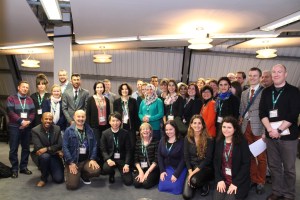
Glasgow 2017 scholarship winners (including Katy)

In the end, after all the build up, I was relieved to finally do my workshop. Due to various complications (let’s just say there are some issues with free speech in Turkey and I wasn’t entirely sure who would be attending), I had changed the content of it substantially since I originally sent in my abstract. Despite being initially worried that nobody would turn up, there was a lovely group of people who were willing to interact and take part in the activities I had planned. Several of the attendees came to chat to me at the end of the session and it felt really good that others were interested in the topic and keeping in touch.

I can finally say I have presented at IATEFL and it was a great honour to be there as the winner of a scholarship. Attending the conference allowed me to get lots of new teaching ideas, meet inspiring people and hopefully get involved with some new projects. I’d like to thank the Global Issues SIG, especially Linda Ruas, for the excellent organisation, clear communication and support in the lead up to and throughout the conference.

‘My first IATEFL conference’ – various contributors

This post is a collection of summaries from four different people who attended the IATEFL conference for the first time in Glasgow in 2017. 

Shay Coyne

About me

I’m a freelance educational consultant specialising in young learners and teacher training & development.

Why I went

I joined IATEFL as I wanted to feel part of a professional group of EFL teachers, and after 3 years as a member I attended because I was a first time speaker and I thought it would be a great opportunity for me to learn and develop from the experience.

The conference

It was by far the best week of my professional career. The Young Learner and Teenager Special Interest Group (YLT SIG) Pre-Conference Event was amazing; the ideas being presented and promoted were things that I believe education to be about. I left the event inspired and motivated to try out these ideas. The YLT SIG allowed me to feel a part of a community of dedicated professionals and I really want to work closely with this SIG.

As a first time presenter I found the experience as a presenter both exciting and daunting. I was so lucky to have Jamie Keddie as my mentor, and his support and advice and presence were a decisive factor for me to be able to stand up in front of a 500-capacity auditorium and not let my nerves get the best of me. I have had positive feedback from my presentation, which is great.

What I enjoyed most was being able to see my EFL friends again and share stories and provide support for each other. I would love to collaborate more with these people as I feel I could learn so much from them, which for me summarises my first IATEFL experience, an experience which I am very excited about repeating again in 2018.

Kyle Dugan

About me

I’m a freelance EFL teacher and Cambridge ESOL speaking examiner in Varese, Italy. I blog about ELT — particularly learner autonomy and teacher development — at dynamiteelt.wordpress.com and I’m on Twitter @kyletdugan.

Why I went

I came to IATEFL this year because my much wiser fellow Dynamite blogger Lindsey Clark knew that successfully proposing a workshop was what I needed to force me to go! And it’s a good thing she did. It got me to pay up, fly to Glasgow, and discover the wonder of my first big ELT conference.

The conference

I think everybody says they go for the presentations but secretly hopes to make great new friends and even rub shoulders with some ELT stars. I got all that, and more.

But what was really great about the conference was meeting and hearing from teachers in many situations very different from my own — teachers contending with stifling bureaucracies, masterminding curriculums, adeptly using all kinds of tech, dealing with challenging issues in class or even living mostly off unregistered, untaxed income. You see the extremes of the profession and industry. On the whole it was very affirming to get a small but significant glimpse of the many thousands of others around the world trying their best to teach English.

And it was lovely to end the week with our workshop – the last-session time slot was great as I had a whole week to watch and learn from others. Looking forward to pitching a new idea for next year!

Anna Bartosik

About me

I am an ESL professor at Sheridan College in Canada. My interests include teachers’ professional development, cognitive learning theories, motivation’s role in learning, and incorporating educational technology in the classroom. I am an active member of TESL Ontario’s Social Content Committee as the Twitter account manager, and I also organize local conferences and co-produce semi-monthly webinars for English language teachers.

Why I went

I decided to attend the IATEFL conference to inform my current research on the situation of international students after the Brexit vote, and satisfy a nagging curiosity to see if I was missing anything as a Canadian teacher practitioner-researcher.

The conference

My first IATEFL conference was a rewarding experience; of course, I had to travel to Glasgow to meet fellow Canadians from Nova Scotia and British Colombia, and the networking with all conference delegates was enjoyable. It was interesting to observe how much of a hold CELTA/DELTA and Cambridge language tests, as well as publishers, have on the profession in the European teaching context.

Carol Lethaby and Patricia Harries’ session on neuroscience’s applications to language teaching did not uncover any surprises for me, but was a reminder that teachers’ continued professional development needs to be regular and contain current, relevant topics in order for teachers to deliver what works, beyond what we think “seems” right. Due to my CPD interests, Gabriel Diaz Maggioli’s plenary synthesized some previously incongruent thoughts clanging in my head. The CPD utopia we keep moving towards as the horizon moves away from us just as quickly and the concept of moving forward, regardless, encapsulated my meditations.

An unexpected surprise was the focus on pronunciation and the PronSIG group. I left IATEFL with some interesting concepts to delve into, especially Adam Scott’s and Adrian Underhill’s different approaches to teaching pronunciation. I also discovered that Canadian research in the field of SLA should be proud of its solid foundations in areas such as translanguaging, social justice, and educational technology.

David Koster

About me

I am a teacher, trainer, and examiner working for Cambridge P.A.R.K., a Cambridge exam centre which organises a conference twice a year in Brno, the Czech Republic.

Why I went

I joined IATEFL and came to the conference for the first time to look for speakers for our conference, to check out new resources, and, of course, to get inspired by new ideas.

The conference

I had prepared for

the conference by reading the programme and by talking to various people about my first IATEFL, but I had not expected to be overwhelmed by the sheer number of seminars and plenaries. I attended many of them and I think you can pick up good ideas or practical activities in every session but I really enjoyed the sessions by Emi Slater and Anna Young and I saw a great practical activity presented by Matthew Calvert and Helen Ford, just to mention a few. I have already presented some of these ideas to my colleagues in one of our CPD sessions and now some of them are now thinking of going to the IATEFL conference in the future. What I liked most about the conference is the fact that you can meet so many different teachers, educators, writers and trainers from all over the world. I know that I am looking forward to the IATEFL conference in Brighton.


Want to join us in the future?

The next three IATEFL conferences will be:

  • 2018 – Brighton 10-13 April, Pre-Conference Events (PCEs) 9 April
  • 2019 – Liverpool 2-5 April, PCEs 1 April
  • 2020 – Manchester 18-21 April, PCEs 17 April

‘My four Cs of IATEFL membership’ by Clare Maas

Conferences

I attended my first IATEFL conference in 2008. I was in awe and overwhelmed at the same time. I tried to attend as many sessions as I possibly could, which kind of back-fired and meant I went back to my hotel on the third day at lunch time exhausted with a headache! Since then I’ve learned how to make the most of these big annual conferences, for example by setting clear aims for myself before I go, and using down time to reflect on what I’ve heard through posts on my blog. I now find that I come away from the annual conference energised and inspired, and full of new input and ideas to apply in my own teaching. The conferences have brought me into contact with lots of collagues working all around the world, and broadened my perspective on good EFL teaching practice. My enthusiasm has helped me to convince colleagues to attend, and this year I even took along a group of MEd students to join in the fun, too!

Contacts

I’ve made some good friends through IATEFL events and groups (e.g. on Facebook). Sometimes we only see each other ‘live’ for an intensive week at the annual conference, but keeping in touch throughout the year means the exchange of input and ideas is not restricted to this one week a year. I’ve also made contact with a number of colleagues in all different areas of ELT, including research, materials writing, etc. who I know I can always turn to with questions or collaboration on any projects I’m working on.

Community

Within IATEFL, I feel integrated, welcomed, and appreciated in the ELT family; my belonging, as a valuable member of this professional community has been confirmed by the warm, inclusive & supportive atmosphere of the whole organisation and at the events. I like the fact that IATEFL reduces the perceived hierarchy between ‘big names’ and ‘normal teachers’ and values everyone’s contributions and membership.  Teaching can often be a rather lonely job, but membership of IATEFL definitely counteracts this!

Continued Professional Development

I’d never really thought about CPD before joining IATEFL. But the events, publications, Special Interest Groups, facebook groups, discussion lists, etc, are all generally inexpensive and accessible forms of CPD which have given me a boost along the way. I only started my own blog because of the excitement around blogging among IATEFL members, and I never would have thought about writing for ETP or MET, or even ELTJ, had I not been encouraged to do so by discussions among members. It’s great working to be the best teacher I can be, surrounded by a whole community of like-minded colleagues!


Clare is a lecturer in EFL and EAP at Trier University (Germany). She holds post-graduate qualifications from the University of Wales and Trinity College London. Before moving into tertiary education, she taught English at German grammar schools, and English for Specific Purposes at several language academies in the UK and Germany. Her professional interests include EAP materials development and CPD for teachers. She blogs at www.ClaresELTCompendium.wordpress.com and on the team-authored blog www.eltresearchbites.com .

‘Q & A from Anthony Gaughan’s webinar on 40 things to do with a text’

On 6th May 2017, Anthony Gaughan presented the following IATEFL webinar:

40 things to do with a text

In this session I will share 40 quick and dirty things to do with texts in our classes.  Many of these ideas will be low – or no-preparation, will work with a range of texts and levels, encourage learner co-construction of lesson content, and will provide opportunities for work on reading, speaking, writing, lexical and grammatical development.   We are all hard-working teachers and I promise you that if you give your time to come to this webinar, you will leave with a month’s worth of activities.  Add your own ideas, and maybe we can hit 50 things, or even 100!

Thank you to the 200+ people who attended, and those who asked questions and offered suggestions. If you would like to watch the recording, you need to be a member of IATEFL (find out how to join), but even if you’re not a member, you can read Anthony’s answers to some of the questions below, as well as extra suggestions from the webinar participants.

What was it like to give a webinar?

This wasn’t the first time that I have taken part in a webinar as a presenter; I chaired an interactive panel discussion on teacher identity for the IATEFL/TESOL Joint Web Conference recently, and have also been “beamed-in” to present at events like the Innovate ELT conference in 2016. So basically I should have known what I was doing. This just makes the fact that I managed to delete my presentation slides – not once, but twice within a minute – all the more, how shall I say? – memorable…

But apart from such minor technical issues, I have to say that I thoroughly enjoyed presenting my thoughts on how to exploit texts in class. I was also genuinely blown away by the number of people who spent their Saturday attending, and was inspired by the amount of participation and conversation between everyone in the room.

Unanswered questions from the webinar

Q: What did I mean when I suggested “expanding a text”?

A text is a partial thing. It is partial in the sense that it is biased in some sense, and it is partial in that it is a selection of content – no text contains absolutely everything that could possibly be said on any given topic. The writer’s job involves deciding what content to include and what content to leave out. Often, these decisions are driven by what the writer assumes the reader will already know. Writers assume shared knowledge with their readership – but second-language readers often lack this information.

As this is the case, we can ask our students to expand any given text by adding information that the original writer left out. This might be small lexical details, such as the age, job and other identifying information for a person mentioned in the text (which works on noun phrase modification, relative clauses etc.), whole sentences or paragraphs of germane information (such as a more thorough description of a place or document mentioned in the text for the benefit of someone lacking the background knowledge assumed by the writer.)

Q: Which of the activities presented would work well with large (70+) classes of elementary learners?

This is a tricky question to answer without knowing a bit more about what technological resources there are available. However, here are some of the ideas I think could work, with some notes on how they could be made to work. Your mileage, as they say, may vary:

Answer or create comprehension questions

Both of these can also be conducted in the students’ first language, as long as the reading or listening text is in the target language. One set of questions and one text can be shared effectively by up to 7 students as the texts will be short and so the print can be large, which means 10 handouts for 70 students.

Role-play

These can be planned, scripted, rehearsed and performed by groups working together, so the teacher has fewer points to monitor than 70 individuals. If circumstances allow, the students could video record themselves performing their role-plays to make post-task feedback on language easier and more time-effective for the teacher.

Convert information into a diagram/visual

This is good because it does not require much productive language from the students but proves their comprehension. Visuals are also quick and easy to monitor (students could just hold them up for the teacher to view from the front.)

Read it aloud

With proper support, as described in the webinar, helping learners to plan to read a short text aloud can be very confidence-building. Again, if students can record themselves, this makes giving feedback easier.

Summarise/Translate it

If the teacher shares the learners’ L1, then asking students to read a short passage in the target language and then summarise it in their L1 is a straightforward comprehension check.

A note on Tagxedo

As part of my webinar, I suggested using Tagxedo to create a word cloud. However, it is unfortunately no longer viable in most browsers because support for Silverlight (a program on which Tagxedo is based) is being abandoned (including by Microsoft, the creator of Silverlight, themselves!)

This means that Tagxedo does not have much of a future – at least as a browser-based option. The developer is working on creating iOS and Android app versions, and has stuck the browser version on the back-burner.

I am slightly embarrassed to say that I only noticed this was the case myself a few days after the webinar when I got a new computer!  I can still use Tagxedo on my old MacBook because it is still running an older version of Firefox (48.0.2 – as I write this, the current version is 52.0.x) but not on my new Thinkpad, which is running up-to-date software.

There are, however, ways around the problem.  Depending on how determined you are to get access, you could install an older version of your web browser – these are generally still available but you are discouraged from installing them because they pose a security risk.  For example, you could download Firefox 48.0.2 from https://ftp.mozilla.org/pub/firefox/releases/48.0.2/ and install from the zip file matching your OS.  This should work with Silverlight after you install this, and then Tagxedo should work for you.

Alternatively, a few people in the chat suggested using www.wordclouds.com, which has many similar functions. You could also try other options from this list of word cloud generators.

A word of thanks in closing

Once again, can I please thank everyone – over 200 of you – who attended, and also if you view this webinar online. It was a pleasure and a privilege.


Anthony Gaughan is a freelance teacher-trainer based in Germany.  He is a Cambridge English-approved Assessor as well as Tutor for the CELTA award and is also a Delta Module 2 tutor; he also works as an online tutor for the Trinity College London Licentiate Diploma in TESOL. He is a state-qualified secondary school teacher in the UK, is an approved Speaking Examiner for Cambridge English exams, and has worked in English Language Teaching for over twenty years in the UK, Germany and Poland. He is a former coordinator for the Teacher Development Special Interest Group (TDSIG) within the international ELT professional association IATEFL, and he writes about minimalist approaches to teaching and teacher training at http://teachertrainingunplugged.com

‘Me, myself, and I…ATEFL’ by James Egerton

Teachers’ associations. 5 years ago. Say what you see: dull, pointless, port, tweed.

The ‘hindsight revisionist’ in me would love to say that I was just setting off on my teaching career at this point, but the raw reality is that I had no idea what I wanted to do with my French and Spanish degree, and heading to Spain to teach seemed like an excellent year-long stopgap while I worked it out. So from that point, how did I get into IATEFL and why do I recommend it today?

Well fast forward to August 2015 and the final day of the six-week Delta Module 2 course at International House London. There was a crossroads about a year earlier: commit to teaching or find something you can commit to. Module 2 was my last of the three modules, and we were given a short talk about what you could do to make the most of the Delta qualification. It was the most fruitful hour of the entire 6 weeks, and I followed most of the pointers: blog like Sandy Millin (I’m not being an editor’s pet; Sandy was the example given), enter academic management, join IATEFL.

Finding out about the 2016 conference when I joined, I signed up immediately. Again, the ‘hindsight revisionist’ says that it was because I was brimming with enthusiasm at the professional development opportunities. Alas! It was because my best friend now lives in Birmingham, so I could spend the week at his house then skip the Saturday sessions to travel up to Liverpool to watch a football match with him. This isn’t just anecdotal; the point is that I was never fully committed to the conference, and without putting much in, I didn’t receive much back either. It was far from a waste of time, though. It was the first time I fully appreciated that I was part of a global community of English teachers, and that people like Scott Thornbury and Jeremy Harmer are not just names on books and bibliographies, but walk and talk too (among many other activities, I’m sure). But I certainly didn’t make the most of it. I didn’t have specific objectives to get out of the four days. I didn’t plan the presentations I would attend, but rather wandered around to see where there were seats. I didn’t enjoy the extra-curricular activities, instead I hopped back on the train to Solihull as soon as possible to spend the evenings with Aaron. I didn’t really network, as I was too overwhelmed with information and really not feeling chatty. I was lost! I sat next to well-known coursebook writer Herbert Puchta in one presentation, for instance, but not knowing who he was at that time, I asked him “What do you do?” when we were making small talk. His face was a picture. He probably didn’t get asked that very often during the conference.

So back I went to Albacete, Spain, went through my notes from the conference, and realised that there was little I could implement in my lessons or in teacher training sessions with the other seven teachers. I’d been to too many research-based talks out of my sphere or teacher trainer talks about CELTA which was out of reach at that point. I grumbled to myself, bitter towards the conference when really it was all down to me, and questioned the point of joining for another year. But the IATEFL magazine Voices kept arriving in my emails every other month, and I kept clicking (not flicking) through it, finding great ideas, putting them into practice. After blogging for several months, I wondered if I could ever get an article published in Voices, so I found the editor’s contact details and sent her an email. After several edits and several months in the queue, I had an article published in the November-December 2016 issue on my favourite topic: feedback and mindset. Every teacher has a unique perspective, so I’d recommend that everyone sit down to write about something they really believe in. Voices editor Alison Schwetlick does an incredible job of pushing you to mould and remould the first draft into something worthy of column inches too, if getting something into print is a motivation like it was for me.

So that’s the extent of my 1 year 8 months as an IATEFL member so far. It’s been useful, sure, but I feel that I really haven’t scratched the surface of the membership benefits yet. Much like I’ve been seeing since joining the International House fold last September, it’s a vast network of teachers who can motivate and teach each other: a genuine rocket boost! As with anything, the more you put in, the more you get out, so I’m set on putting a lot more into the organisation from now on. It starts here on this blog, which I hope to make a regular contribution to. Next is getting involved and active in a SIG, whether it be through webinars, papers or communicating with like-minded professionals. And of course I’ll have to right the wrongs of the 2016 conference. Although I wasn’t able to attend Glasgow this year, I won’t miss 2018, armed with objectives and a plan and hopefully presenting too. So five years later on, I’d throw back the following as a ‘say what you see’ on IATEFL: opportunities, ideas, sharing, development.


James is a Delta-qualified teacher and rookie teacher trainer currently working at International House Riga-Satva in Latvia. His extra pedagogical activities include working as a writing and speaking examiner, and integrating basic psychological principles into TEFL to help learners and teachers. He blogs on his reflections of learning and teaching English at www.jamesegerton.wordpress.com.

‘GISIG and me. And you!’ by Gergő Fekete

G I S I G. 5 letters, 12 committee members, 162 members, and a lot of enthusiastic followers. Even though our Global Issues SIG is considered small among IATEFL’s SIGs, we are very proud of what we represent and what we do. Which is what …? – you may ask.

GISIG provides a forum among ELT practitioners to stimulate awareness and understanding of global issues. It is for teachers who see themselves as educators in addition to teaching the language and who are keen to bring real-world issues into the classroom, instil a sense of social responsibility, and develop critical thinking skills.

Our eLesson Inspirations page. To get started, go directly to the eLesson Inspirations archive page

I still remember reading these lines on the GISIG website 2 years ago when Margit Szesztay, former GISIG coordinator and my beloved methodology teacher at ELTE University in Budapest, familiarised our group with the SIG in one of our sessions. One of the first things I came across was the eLesson Inspirations section, which includes lessons built around short videos to make students think and explore real-world issues while also learning English. I tried many of the activities with my students myself, such as the one designed for ‘The Social Experiment’, a video about high school students trying to give up their virtual identities for a week, and my other favourite: ‘One-minute meditation’. Did you know that you can make a meaningful change to your state of mind in a fraction of a second?

So, I got really excited, so much so that actually I decided to design my own eLesson unit on bullying. Then, after writing a workshop summary and a very short review of Ricardo Sampedro and Susan Hillyard’s Global Issues, Margit asked me if I wanted to join the SIG as Social Media Coordinator. And why would I have missed this great opportunity? There is so much I can learn about, share, try out, and reflect on. To give you a taste, let’s have a closer look at what exactly we offer.

  • Going back to the eLesson units… have you got a catchy short video in mind that deals with a global issue, is thought-provoking, and you think would work well in your lesson? Do let us know and send us your ideas following these guidelines. We look forward to posting your eLesson on our website.
  • We would also like to support teachers in difficult circumstances, e.g. teachers with no resources or with very large classes in refugee camps. Read 3 short articles about teaching in refugee camps in our June 2016 Newsletter.
  • Every year, we organise a month-long online event called the Issues Month. The idea behind the Issues Month is to share lessons and strategies that raise awareness in your classes and your schools about content that matters. Do browse our archives on the previous Issues Months centring on Gender issues (2016), War and Peace (2015), Home and Shelter (2014), and Food issues (2013). Stay tuned for our next Issues Month in October 2017!
  • Our Calendar of Special Days is also there for teachers all year round. In each month, we feature at least one special day that helps you deal with an issue of global significance as well as a language point. If you wish to attend our IATEFL Pre-Conference Event in 2018, let me invite you to take part in our competition and submit a lesson plan about a special day to add to our website collection. Deadline: August 31, 2017.

GISIG at APPI in Lisbon

As a beginner teacher, looking at the list above, I felt very lucky, as I got an amazing number of ready-to-use ideas that helped me a lot while doing my teaching practice. Now, at the end of my M.A. programme, I even had the chance to present my global issues related thesis on the film ‘Girl Rising’ at the APPI Conference in Lisbon under the auspices of GISIG with 3 wonderful colleagues: Linda Ruas, Stella Smyth, and Margarita Kosior. This, along with all the points mentioned in Clare Maas’ 4 Cs of IATEFL membership blog post, helped me become even more certain that the English language teaching profession and community is one of a kind: it’s supportive, positive, inclusive, and welcoming.

Well, as my word count limit is slowly but surely coming to an end, it’s time I put the question: is it clear WHY global issues? Should you need some more information, please have a look out our website, like us on Facebook and follow us on Twitter. Oh, and read the book of one of our Joint Coordinators, Linda Ruas, that asks the exact same question and is now hot off the press.

“Why Global Issues?” by Linda Ruas

Looking forward to attending my first annual IATEFL conference, I hope to see you in Brighton in 2018.


Gergő Fekete is a teacher of English and German in Budapest, Hungary, and also the Social Media Coordinator of IATEFL’s Global Issues SIG. After studying in the U.S. and Germany and completing an M.A. in Hungary, he is now excited about throwing himself into full-time teaching in Budapest and making the best use of his recently completed CELTA to teach in other countries, too.

‘From checklist to reality check: The never-ending nature of professional development’ by Wiktoria Parysek

Last year, after completing the input portion of my CertIBET with Helen Strong (IATEFL BESIG’s Events Coordinator) I made an action plan for my future as an English instructor. If you’re a CELTA graduate or have completed any kind of additional ESL qualifications, this is probably a practice you’re quite familiar with.

While for some, the short- and long-term goals may be simply throwaway ideas to end the course on, for me they are a chance to reflect and look ahead: something I don’t often have time to do, especially as a freelance English trainer. The luxury of sitting down to think about what I truly wanted out of my career was wonderful. My short-term goals included the following:

  • become a member of IATEFL
  • subscribe to a teaching journal
  • continue work on my one-post blog
  • encourage more knowledge transfer among my colleagues

I became a card-carrying member of IATEFL (and BESIG and MAWSIG) at last year’s BESIG conference in Munich. Check. I realized that my local teachers association, ELTABB, already subscribes to the teaching journal I wanted to sign up for – English Teaching Professional. Check. At this next point I will humbly admit defeat. My blog is just as empty as it was at the end of last year. However, while browsing other blogs for inspiration (in this case Chia Suan Chong’s ETp blog), I learned about the fairly new ELT Ireland conference in Dublin. I did some research and discovered that their call for papers deadline for their annual conference was just 9 days away. After a frantic email to my CertIBET trainer and a gentle nudge from her to go for it, I submitted my proposal to talk about using podcasts in the classroom. A few short weeks later, my talk was accepted and—suddenly—check: the last point in my action plan was well under way.

Cue the panic. OK, at first there were celebrations, of course, and the excitement of looking for a hotel and booking my flights (maybe not so exciting for seasoned travelers). But then it actually hit me: I have to stand up in front of a room full of teachers (but what if no-one comes?!) and talk for 45 minutes (what if people leave half-way through?!) about a topic they expect me to be some kind of expert on (they’ll see right through me!). Major impostor syndrome kicks in. What do I do to deal with it? I procrastinate.

I put it off and the weeks fly by. Suddenly, conference weekend is barreling towards me and it’s time to get to work. I take what I’ve been teaching my business English students about presentations and finally put it into practice. In the weeks (OK, days) leading up to the conference, I work furiously, using every spare minute to make notes on the presentation, move slides around, check the timing.

Conference weekend arrives and I’m off to Dublin. I arrive at the hotel and force myself to power through, finish the presentation, AND do a run-through before I allow myself to see any of the city. Let me tell you: that’s pretty good motivation when you’re in Dublin for about 48 hours and, believe it or not, the sun is out. My nerves, even when speaking to my hotel room door, are through the roof. But I get through the presentation, the timing is fine, and it’s finally time for a walk through the city, followed by fish and chips and an ice-cold cider.

The rest of the conference was a blur. The organization by IATEFL Associate ELT Ireland was flawless, the hosts and local attendees lived up to the Irish stereotype and welcomed me with open arms and warm hearts, and—believe it or not—people did actually attend my talk! They even tweeted pics and gave me some great feedback afterwards. One participant and I chatted about transferring some of the things I talked about to task-based learning environments and I was flattered to hear from some that it was their favorite talk of the conference. Great! Job done! Or so I thought.

I went back to my original goal: “encourage more knowledge transfer among my colleagues.” Check? Not quite. This goal is ongoing, just like any type of learning. Rather than seeing this as a destination, a gold star to be won, I am starting to see it as an underlying motivation. The things we learn as teachers should not be kept secret; they should be shared with others through our local teaching organizations, local and international conferences, and online communities.

I had expected to leave Dublin thinking “Phew! Glad that’s done.” But instead I left thinking “Great! What’s next?”


Vicky has been teaching English since 2013. She is the Head of the Competence Centre for Teaching English at the University of Applied Sciences, Wildau in Germany. She holds a BA from the University of Pennsylvania, an MSc from the University of Edinburgh, a CELTA, and a CertIBET. Vicky’s professional interests include task-based learning and learner engagement. Her personal interests include cooking and playing rugby (much to her mother’s dismay). She tweets @vickyparysek.

‘ELT events and the gender balance of speakers’ by Tessa Woodward

Been to an ELT event lately? Lots of women teachers there? Quite a few women presenting workshops too? Great! How about the plenary speakers? One woman and four men, you say. Hmmm. That’s a pity!

Why is gender balance at ELT events so important?

Well, let’s go back to basics. Many teachers of EFL/TESOL are women. It is only fair then that there be many women senior academic staff, owners and principals of language schools, and presenters and plenary speakers at ELT events.

Women have talents and ideas aplenty so, if we are not hearing their voices during plenary talks at conferences, we are all missing out on varied, interesting ideas. Presenting work at a conference is a great spur to creativity and thinking in the presenter, as well as to career movement, publication in conference proceedings, promotion etc. If women don’t get or don’t take these chances, they miss out.

Some men who find themselves the only gender represented in a list of plenary speakers or on a speaker panel and then talking to large numbers of women participants, find this an odd experience. ‘Why am I up here on the podium and the women down there in the audience?’

There are plenty of women participants at ELT events. If they are not represented in the balance of speakers in front of them, this may feel demeaning to them and lower their self-confidence.

If there is only one woman on a speaker panel, it becomes easier for her voice to be ignored, or for her to be talked over amongst the, understandable, male camaraderie. More women on the panel? The dynamic changes and the women there may feel more comfortable too.

The more women accept invitations to give workshops and talks, the more practice they get, and the better they will get at it. You have to do workshops and talks to get better at doing them.

Why are ELT event speaker lists sometimes so stuffed full of men?

Some events are evenly balanced. Others, sadly, are not. Why not? I feel there is a bit of a vicious circle going on. If it is usual to see lots of men presenters at events, this imbalance will start to feel ‘normal’. As a result, having more than one woman speaker may, strangely enough, start to feel ‘abnormal.’ Even a ratio of five men to two women speaking can lead people to say, ‘There were loads of women speakers!’

If the same gender and the same ‘names’ come up all the time as speakers, these oft-mentioned people are seen as more important than others. It gets harder for organizers, women or men, to remember other speakers’ names. So, the pool of those up for invitation gets smaller and shallower.

But below is a picture of a very possible and more virtuous circle for plenary and in fact any speakers!

What is being done about this?

In 2013, I set up The Fair List, UK. This is an annual award that celebrates excellence of gender balance in plenary speakers, presenters and speaker panels at ELT events, in the UK. The group supporting the award believes that good gender balance at UK ELT events will ensure wide coverage of relevant topics and a more balanced perspective on the issues affecting both women and men in their professional lives. It will also help to reflect the composition of the UK profession.

From the start The Fair List, UK has had tremendous support from individuals and organisations. One instance of this is that IATEFL, in its desire to celebrate diversity, has offered us a place at conference to hold our awards ceremony. Incidentally, IATEFL has been on The Fair List itself for main conference plenary speakers, for its web conferences and webinars and a large number of IATEFL SIGs have been on it as well!

The Fair List, UK and its mentoring scheme

As well as our annual awards, we have a great web site full of resources at www.thefairlist.org

We have also started a mentoring scheme. We now have a team of talented volunteer mentors waiting to give support to women who are preparing to run workshops, do presentations or become plenary/keynote or panel speakers at UK ELT events, and who would appreciate a bit of support. You can find out more on our Mentoring pages.  

So, if you have a conference presentation coming up, need help with a webinar or are worried about giving a TD session, get in touch with me and, once we have discussed your aims, we can try to fix you up with a mentor.

Looking forward to hearing from you!

Tessa Woodward (Founder of The Fair List)

Email: [email protected]


I recently retired as a teacher, teacher trainer and Professional Development Co-ordinator at Hilderstone College, Broadstairs, UK. I edit The Teacher Trainer journal for Pilgrims, Canterbury, UK. I am a Past President and International Ambassador of IATEFL and founded the IATEFL Special Interest Group for Teacher Trainers (now the SIG T Ed/TT).

I have written books and articles for teachers and trainers. The latest one, with Seth Lindstromberg, is Something to Say, (2014, Helbling Languages).

I’m in the middle of another one about teacher development over time. It might see the light of day in 2018 if I and my co-authors are fortunate!