Practice what you preach, study what you teach by Ian Butcher

Great teachers often don’t make the best students, at least in my experience. Over the years, I have collected a number of tips and tricks which I relentlessly try to embed into my students’ approach to language learning, but it was not until the lockdown that I actually started taking my own advice. Doing so, Ι  took my German from A2 to B2 in a matter of months; 81 days to be exact. Since then I’ve been asking myself, in German, warum did I leave it so lange to start taking my own advice?

At different stages of my teaching career, I think back to my training in the hope of  hopes of gaining some deeper insight. At first, I would pick over the remnants of those memories in an attempt to dust off a technique or unearth a solid-gem of an activity that I could integrate into my current teaching context. More now than ever, I find myself reflecting on how I was taught to teach. I think about the activities garnered from an eclectic cocktail of teacher trainers that I enthusiastically guzzled down, garnished with their practices and beliefs, and realise there is a slightly sour taste in my mouth.

“A sour taste” might sound a bit harsh, but there was something not quite right with the execution. I’ve never understood why any TEFL or SLA course would stress the importance, let’s say, of learning style preferences, and then have students write essays in response to long strands of text in order to demonstrate their acquisition of the concept. This was exactly what happened on an asynchronous course that I took part in. Surely the best way of teaching students techniques for the classroom is to implement them into how you teach such techniques. Where are the videos? The podcasts? The video message systems? There is clearly a disconnect between theory and practice found at many levels of education. 

It is clear that this is something many of us within the profession are aware of. Whilst discussing the idea for this article with various colleagues, one described a workshop on differentiated teaching strategies that she attended. Surprise, surprise, the same tasks were set for all attendees, and the same mode of delivery was used for the content of the workshop. 

Evidently, it’s often easier to know how to do something than to actually make it happen. as was the case for the German state-exam exam board (oh, I know this one…Staatsexamensprüfungsausschuss). Another colleague recalled having once taken an exam on how to set German state exams, and was shocked by how little thought had gone into preparing it. They commented that had the roles been reversed, the German state-exam examiners might have failed. 

A further example can be found in how courses address the affective filter hypothesis. In fairness, at least many of these courses do mention it. They introduce it to their students, they plant the seed, but what next? After exploring how anxiety can negatively impact the learning process, they then pile it on. Time sensitive tasks, final grade weight-bearing deadlines, the warnings that precede and follow from both trainers and former trainees, it isn’t exactly a bubble bath, more so a baptism of fire. 

It is a real shame how many people are scared off from the idea of taking advanced teaching courses. Think just how many more incredible teachers there would be. Even now, I’m speaking with teachers with years of cultivated experience and passion who are choosing not to delve deeper for fears of how they would cope doing such teaching development courses. Their own passion for learning is quashed by the way these courses are designed and implemented. 

But does it have to be this way? Obtaining an education can be stressful enough, with the costs incurred and the concerns of what to do with it once you’ve gotten it. Does the process really have to be quite so painstaking? 

I’ve fallen guilty of this myself having just delivered a workshop on concept checking questions without including a single one; hindsight is a wonderful thing, although sometimes, it’s also just embarrassing. 

At the risk of causing myself even further embarrassment, I should reveal to you, dear supportive reader, that I have done it again; in this article no less! Over the last 2 years, I have been teaching EAP writing courses. I regularly stress the importance of brainstorming and planning. However, with this article, I skipped the planning phase. Fortunately, a good friend pointed out the disconnect and encouraged me to practice what I preach!

Of course, this isn’t just in our professional field. My mother has 40 years of experience raising children; 6 of whom were her own sons, many more were other people’s children. The one thing that has constantly tested her resilience and desire to continue doing what she is so incredibly good at? The constant training that is imposed, the way that it is delivered and the disconnect between theory and practice.. 

In order for this to change, we need to have a closer look at our own practices. The old saying “If you can’t do, teach,” only applies to those that let it. We shouldn’t let this be a defining quality of our profession, and everytime we forget to ask that CCQ in a workshop or put result levels over anxiety levels, that is exactly what is happening. 

In future, I’ll be making a more conscious effort to consider the content of my lessons and to what degree I am modelling what it is I want my learners to do more successfully. It may be a simple case of being more mindful during the planning stages and taking the time to reflect on the success of the class; an approach that I picked up from one of the more successful developmental courses. 

About Ian Butcher


Ian Butcher is currently teaching at the University of Munich. He’s half-way through the 

Distance Delta and weeks away from getting married to a truly wonderful woman. 


Contribute to the blog

If you are a member of IATEFL and would like to contribute to the blog, we’d love to hear from you at [email protected]. We’re looking for stories from our members, news about projects you’ve been involved in, and anything else you think those connected to English language teaching would be interested in reading. We look forward to hearing from you! If you’re not a member, why not join us?
See VIEWS Guidelines and Ideas

Follow-up to Webinar “The Neuroscience Factor in Language Learning”

On 3rd September, I had the pleasure of delivering this Webinar for the IATEFL community of teachers and followers. I do hope this follow-up article triggers more questions than answers. THANK YOU!

The end of an era

It’s not difficult to see now that some paradigms are falling. The traditional educational system is undoubtedly one of them.

In the era of technology in which the workforce is being replaced by machines, robots, computers, etc., we can easily see how jobs that were once needed are now disappearing, at the same time and speed that new ones are being created. This era of rapid changes cannot wait. It is here to stay and evolve and the ones who are unable to adapt to it, will eventually “lose”.

The traditional educational system or the industrial education was designed with one purpose in mind: to create automated workforce that could work in factories, performing automatic tasks. There was no creativity, interaction, discussion, evolution or growth in them. Basically, they received orders. The educational system that started in the industrial era and still continues today (yes, today in the technological era), only prepared students to obey, not to create. Students and later workers were not considered as humans but as machines that needed to produce. What about their feelings? What about their wishes and dreams? What about their talents? What about their personal and professional evolution? None of it existed.

We watched this video to better illustrate this idea: (https://youtu.be/okpg-lVWLbE )

Neuroscience and Education

Neuroscience in the area of education, Educational Neuroscience or Neuroeducation, is a relatively new field. It emerged in the 90s to offer an alternative view to approach education; in a holistic way. What does it mean approaching education holistically? It means considering the human being as a whole by a deep understanding of how our brain and our mind work. Backed up by the latest research of neuroscience, cognitive psychology, biology, human evolution, emotions, among others, we can now access tons of information just a click away. When you start seeing yourself as a holistic individual and learner, you’ll be able to understand others and be able to help them. It’s a transformative path that we, as educators in this era, should be willing to walk on. You could find suggested bibliography and renowned authors in this document I’ve carefully created (https://drive.google.com/file/d/1nfXvaJAj6dM53bHb82rlOSQilhakA-sh/view?usp=sharing)

The theory of the three brains (The Triune Brain) by Paul McLean

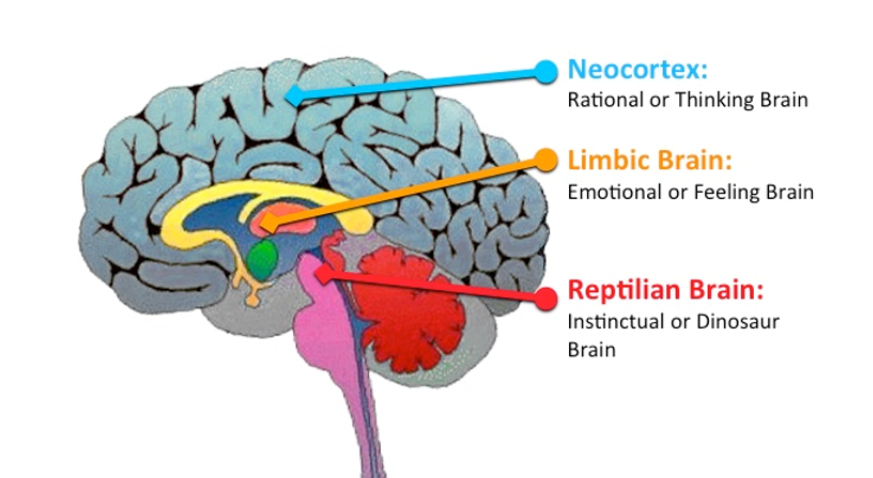
Paul MacLean, an American psychologist from the 60s developed the theory of the Triune Brain which proposed a division of the brain in the order it evolved through history. Of course, it’s an oversimplified model and explanation of how it works since it has been proved and demonstrated that such a division doesn’t exist, all the parts of the brain are connected. Anyway, it’s still a useful way to understand the relationship between structures and functions of the human brain.

Image 1: The Triune Brain

According to this theory, the first brain, the reptilian brain, is worried about survival. In relation to learning, we understand that the basic needs have to be covered in order to be able to learn properly: feeding, sleeping, body temperature, clothing, etc.

In this automatic and repetitive mode, the reptilian brain will always be on the alert, trying to spot dangers – threats – (in the case of education it could be the classroom, classmates, teachers, contents, grammar). Thus, one of the tasks of the teacher should be to reduce threats.

The limbic system is considered the emotional system, which in education can also be related to motivation, and it’s also connected to our memories (partly short term, but mostly long-term memories). And of course, it also has to do with the social part, the interaction and bonds we create with peers and teachers.


The third brain is the Neocortex, the rational brain (the most evolved area and the one that involves cognitive functions such as planning, organizing, creating, thinking, reflecting, etc.) Of course, this is essential to have in mind when designing and proposing tasks, but not the only one.

ALL of them are important when learning, we should know and integrate the “3 parts” and not only focus on the cognitive area.

Learn more about this theory here: (https://www.interaction-design.org/literature/article/the-concept-of-the-triune-brain)

How do we learn? Neural Networks

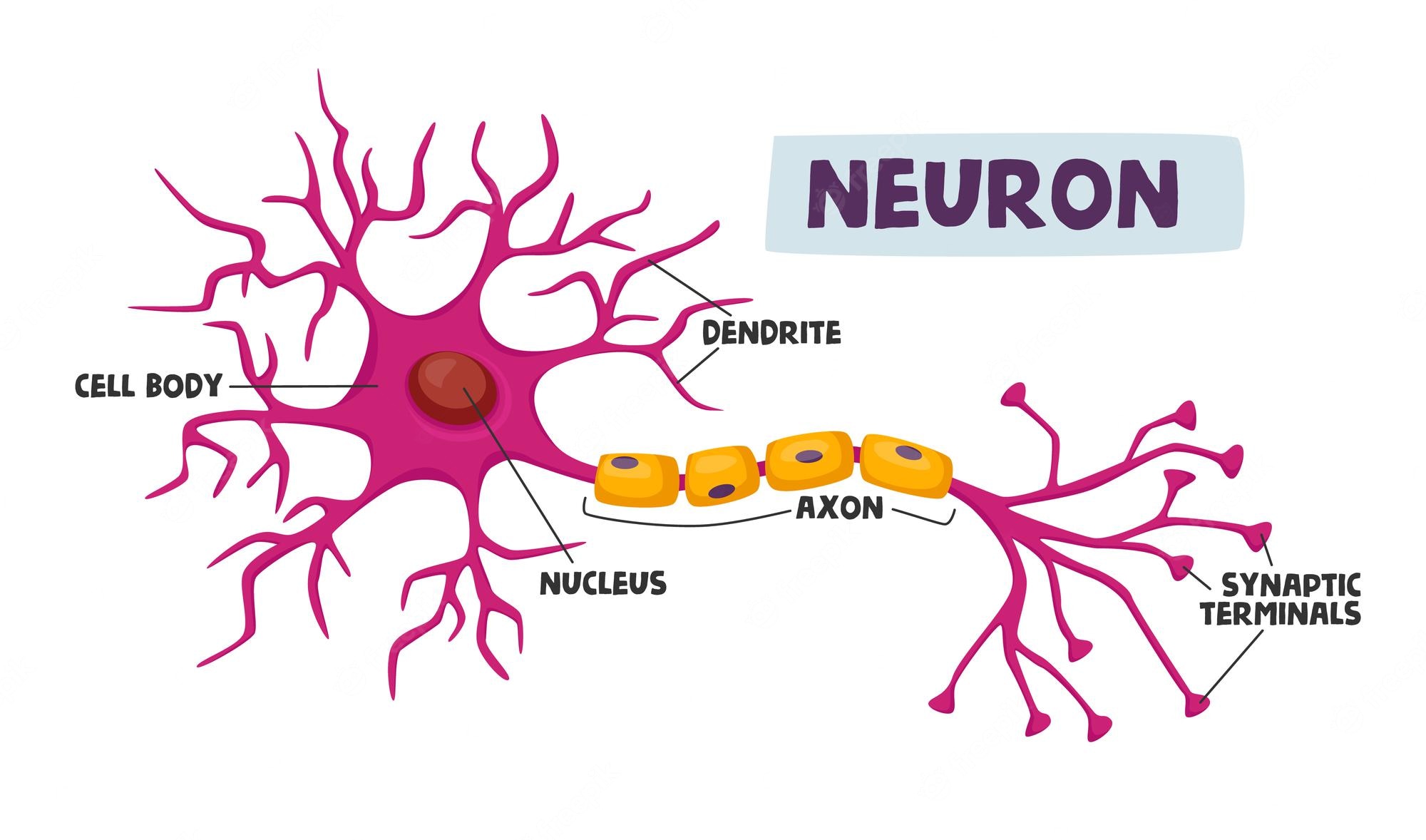
Our brain is made up of networks of interconnecting nerve cells called neurons. A neuron is made up of three (main) parts: A Dendrite, an Axon and a Cell Body. The dendrites receive (they are receptors) the chemical signals from the axon (they are transmitters).

The information travels along the axon body and when it reaches the end, it releases chemical signals (neurotransmitters) into the synaptic cleft (they don’t touch each other)

Image 2: Neural Networks

The creation of a neural network is like blazing a new trail in a thick forest. Every step requires effort and you’ll have to walk many times through it in order to make it visible. Therefore, in order to learn or unlearn something, we have to make an effort to do it repetitively and constantly, until it becomes automatic, a habit (and do it with our subconscious brain). (https://youtu.be/_nWMP68DqHE)

Releasing Neurotransmitters

What are the neurotransmitters we want our students to release?

There are two groups of neurotransmitters, called the “positive” and the “negative” ones depending on what they produce on our brain and body. The negative ones, or the enemies in learning are for example, cortisol, adrenaline and noradrenaline; they block the brain since it feels threatened, which activates the fight or flight response.

The positive ones, the “Happy Neurotransmitters” are the ones we want our students to release: dopamine, endorphin, oxytocin and serotonin. The powerful mix of these will create an ideal learning state in which the brain will be willing and excited to learn. What should I, as a holistic teacher or coach, do to trigger their release? What should I consider adding or changing in my lessons? What should my role be? Will my practices change after knowing about neuroscience? Food for thought!

In this era, not only of technological changes but also of consciousness in many different areas, we, teachers, should be the main actors and promoters of this evolution in education. What we actually DO will make a difference, not what we KNOW.

If you want to know more about Neuroscience, Coaching and NLP in Teaching, please feel free download this short E-book with some useful tips to start putting into practice right away.

DOWNLOAD it from this link: https://dreamon-elc.com/lp-ebk-free-002/

About Roxana Areán

Roxana Areán is a graduate English Teacher and Translator with a Master’s degree in Audiovisual translation from the University of Cadiz, Spain.

She is also a certified Neurolanguage Coach® (Efficient Language Coaching, UK), a Neuropsycho educator (Asociación Educar, Argentina), a certified Biodecoder, and is currently studying NLP (Neuro Linguistic Programming).

In the last years, she’s been fully devoted to studying the human brain and the mind and applying scientifically proven techniques that have had great results and which keep thousands of students satisfied.

With over 15 years of teaching experience and the knowledge of all these complementary disciplines, she is eager to share and expand this new and revolutionary way of education, which not only improves but also empowers our students’ learning.

She is the founder of Dream On ELC (Argentina); an online academy which offers courses and Webinars – both for students and teachers – integrating neuroscience, coaching and emotional intelligence.

Contribute to the blog

If you are a member of IATEFL and would like to contribute to the blog, we’d love to hear from you at [email protected]. We’re looking for stories from our members, news about projects you’ve been involved in, and anything else you think those connected to English language teaching would be interested in reading. We look forward to hearing from you! If you’re not a member, why not join us?
See VIEWS Guidelines and Ideas


Follow-up to webinar on Extensive Reading with Thomas N. Robb

On 6 August 2022 I was privileged to be able to present an IATEFL webinar on my views on the application of Extensive Reading as a means of providing students with one essential that is often lacking from their English learning – the opportunity to practice what they have studied. Unfortunately, there wasn’t sufficient time to address the 30+ questions that had accumulated during my talk, so I’d like to cover as many as possible in this blog, within the strict word limit.

The rationale for Extensive Reading can be explained like this. In many classroom contexts around the world, there is an overemphasis on covering the material in the textbook and various forms of assessment which leaves little or no time in class for students to simply read for information rather than focusing on the grammar and vocabulary of what they are studying.

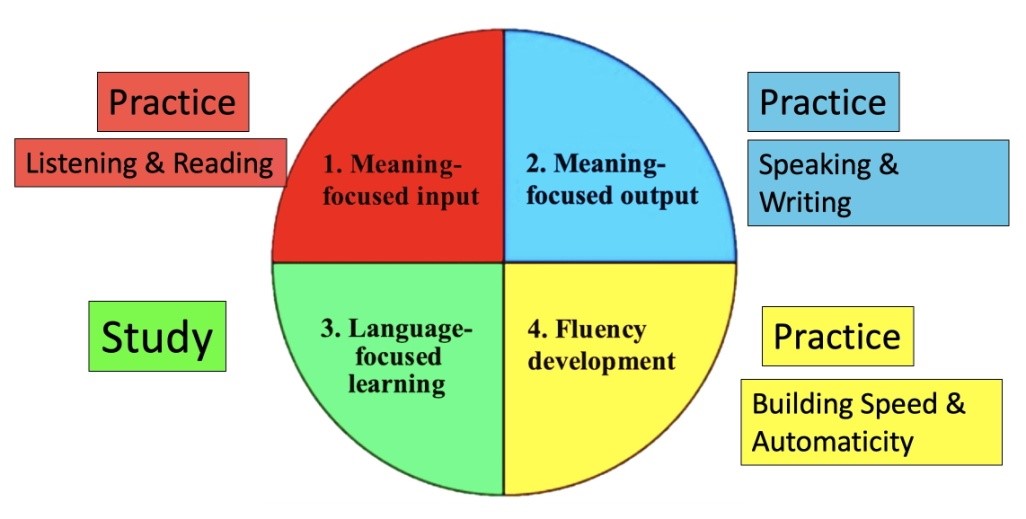
Dr. Paul Nation’s “Four Strands” concept advocates providing more opportunities for students to practice meaning-focused activities for all four skills, as well as time for fluency activities where they can use the language that they already know. Meaning-focused receptive activities (reading and listening), meaning-focused production (speaking and writing), and fluency activities on all skills should each comprise 25% of the students’ overall language learning time. This leaves only 25% for language-focused studythat in many classes comprises 90% or more of class time.

Definition of “Extensive Reading”

The basic concept is for students to read a LOT of material, focusing on the meaning rather than the language. This generally precludes reading material used in the standard texts since it is designed to expose the students to new language – vocabulary and grammar – with little time available for other 3 strands of language practice. Self-selection of reading material, reading at one’s own pace with material that it sufficiently easy to be read fluently with little dictionary look-up is the norm.  These criteria are usually met by having students read from graded readers that they select themselves from a library with a wide range of topics and ability levels.

Below are the main categories of questions, with my responses.

Materials

Where can I find the extensive reading material?

“Graded Readers” are the best source since they have been written in graduated steps to make it easy for students to read fluently with little recourse to a dictionary. “Leveled Readers” designed for native learners are usable, although they often contain vocabulary and idioms that native children might know but our learners do not.

Online material is also available, but care must be used that it is suitably graded.  Two sites that I recommend are:https://er-central.com  and https://readtheory.org.  Both are free and permit you to register and track your students’ progress, but of course this assumes that the students have sufficient online access.

Another site which has PDFs of some graded readers and lists of online material at various reading levels is https://freegradedreaders.com, much of which can be printed out and distributed to your students.

As a last resort, you might try taking some digital texts that are too difficult for your students and running them through software such as “Vocabprofile” on https://lextutor.ca which would flag the words that your student might not understand by comparing them to a prepared list of words commonlystudied or known by learners, such as the New General Service List. You can then simplify the text down to a level they might understand or perhaps provide a list of definitions for the difficult items.

Getting the students to read

When dealing with intact classes, not everyone will be excited to read – even if the books are at their own reading level and of potential interest. If you have a small number of students, you can talk to them regularly about their reading, but in the case of large classes or have multiple classes, this is not feasible. Often some kind of tracking, be it a reading log, feedback sheets requiring simple, brief responses or a wall chart will encourage many to continue to read. Setting a target, often based on each books’ word count will give them a tangible goal and a grade on their ER, pegged to the number of words read can be a great incentive.

Where to read

While some activity in class is needed in order acquaint them with the basic principles of selecting easy books, how to read quickly without worrying about perfect comprehension, etc., but having the students read outside of class is ideal since it does not interfere with the already overloaded curriculum. This, of course, implies that the students can take their reading home. ER can also be conducted in class where a specific period of time, perhaps 15 minutes is scheduled for it daily.

Following up

While students who become excited about their reading might continue to read without further pushing, most students would prefer to use their free time on other activities, such as other preferred subjects, sports or social endeavours.Follow-up activities will vary depending on whether they have read different books (the usual case) or the same one, such as when using a “class reader”. Either way, structured small group discussions will provide a handy way to increase their understanding of what they have read and sharing their thoughts might stimulate the others to read the same book. If their speaking proficiency allows, they can present the book in English (perhaps with a few days warning to make it an English fluency activity), but even a discussion in their own L1 can be beneficial. Bamford & Day (2004) contains a wealth of crowd-sourced ideas for follow-up activities.

How old do students have to be?

The earlier the better! Of course, the students must have recognition ability for the first 100-200 commonly taught words, but this is sufficient since many books for children are available that use limited vocabulary. Books in NGL/Cengage’s Foundations graded series start with a headword count of just 75 words.

Links to books and software mentioned in this blog are available here.

The original webinar: IATEFL members can watch the recordind of the original webinar by logging onto the IATEFL website, selecting ‘My Resources’ and searching for ‘Extensive Reading’.

About Thomas N. Robb

Thomas Robb, Ph.D., University of Hawaii, is Professor Emeritus, Kyoto Sangyo University. He is a long-time user of CALL and the Internet, and has created a number of websites and applications for Extensive Reading, student projects, interactive learning and professional exchange. He has held numerous leadership positions in International TESOL, JALT (Japan) and PacCALL. He is now on the steering committee of the IATEFL LitSIG and is Chair of the Extensive Reading Foundation. He is also the Editor of TESL-EJ,  the first online journal for ELT.

Contribute to the blog

If you are a member of IATEFL and would like to contribute to the blog, we’d love to hear from you at [email protected]. We’re looking for stories from our members, news about projects you’ve been involved in, and anything else you think those connected to English language teaching would be interested in reading. We look forward to hearing from you! If you’re not a member, why not join us?
> see our blog guidelines and ideas


Pop culture in the teen ESL classroom

Pop culture in the form of movies, songs and other forms of mass media can infuse a whole lot of fun in the teen classroom while also supporting learning.

In one of my early creative writing classes many years ago, I happened to ask my students if they knew what “MTV” was.  The mention of the erstwhile epitome of pop music was received by a collective blank stare from my class of  ten 13-year-olds.

After what seemed like an endless period of silence, one student said quietly , “I think I may have heard of it,” almost as if to console and assure me that I was not the ‘uncool’ one for asking if they knew about the now obsolete music channel. I almost wanted to ask incredulously “ How could you not have heard of MTV?!” Instead, I took a deep breath and explained, “ It was like YouTube on TV with mostly music videos.” Fortunately, I saw a few slow nods.

Teaching teens is always dicey. Add the online component and you have string of new challenges– cameras switched off, silent break out rooms and frequently flagging interest levels. The last thing you need, therefore, is unrelatable content be it an online or offline class.  

Pop culture references, when used right, can be a great way to engage your teen students and connect with them. In fact, if you use songs and movie clips in your classroom, you are already using pop culture!

Here are some of my top tips of using pop culture effectively in the teen classroom :

Get to know your students’ interests

The ice-breakers and getting- to- know- you activities typically done on the first day of the semester are a great opportunity to make a note of your students’ interests, likes and dislikes which will then help you tailor the content to their needs. 

The classic ‘Would you rather’ ice breaker can be easily adapted to include pop culture references which could raise the fun level a few notches. Here are a few examples :

Would you rather read the Harry Potter books or watch the movies?

Would you rather watch Harry Styles in concert or BTS?

Here’s another fun activity — let students introduce themselves by writing a tweet of 280 characters. Encourage them to use fun and relevant hashtags. Always remember to do a demo first before you ask the students to do the task. 

It was in one such ice breaker activity I realised my students’ love for Percy Jackson. Knowing this then helped me use some lessons based on the Percy Jackson books, which turned out to be a hit.

One of my favourite activities is around the last few minutes of this incredible video of Akala freestyling a track which has 16 of Shakespeare’s quotes interwoven in them. Watching this has inspired many a brilliant slam poetry performances in my class.

Let students become the teachers

Teens, especially older ones, are on the precipice of becoming adults and often prefer to be treated as grown-ups rather than as children. Allowing them to take the lead at times gives them the sense of responsibility they crave. I have learned to relinquish some control while teaching teens and allow them to lead the class. For instance, while teaching blogging, I used to often show them the usual platforms like Blogger and WordPress. However, it was my students who introduced me to more exciting platforms like Wix and Weebly for which they created accounts under the supervision of their parents. 

Once you become familiar with their interests, use these topics to generate discussions and focus on language points. This blog post on Kanye West could evoke quite a few heated discussions!

Stay cool to be cool

While sharing fun videos and memes in class is a great way to build rapport with students, it is important to ensure that the content is culturally and age appropriate. Additionally, since pop culture elements are largely pieces of creativity, it is also important to check the copyright guidelines related to them. 

So, the next time you want to strengthen the rapport with your new batch of teen students or just zhuzh up the class a bit, don’t be afraid to bring in a little bit of song, dance and even drama!

About Ananya Banerjee


Ananya is a trainer and teacher-trainer at British Council, India, with over seven years of experience and specializes in teaching young learners and creative writing. She has the CELTA and DELTA qualifications from the University of Cambridge. When not working, she can be found reading a fast-paced thriller, practising yoga, or watching reruns of her favourite shows. She can be reached on LinkedIn here.

Contribute to the blog

If you are a member of IATEFL and would like to contribute to the blog, we’d love to hear from you at [email protected]. We’re looking for stories from our members, news about projects you’ve been involved in, and anything else you think those connected to English language teaching would be interested in reading. We look forward to hearing from you! If you’re not a member, why not join us?

> see our blog guidelines and ideas

An interview with Kristina Gregorčič

The age structure of IATEFL shows that at the moment most members are in their forties or fifties, while the percentage of the youngest, those in their twenties, is more than three times lower than either of the strongest two age groups. Here’s an interview with a young IATEFL member and a young teacher, who has been with us for just over a year. Mojca Belak has interviewed her for Views. 

Mojca: Kristina, you have now been a member of IATEFL for a bit more than a year. Why did you join?

Kristina: I don’t think I have told you this before, but it was you who made me enthusiastic about IATEFL. In 2015, you invited your students to prepare short presentations for the international conference organized by IATEFL Slovenia. I was a BA student then, and I plucked up the courage to give it a go. I still remember the welcoming atmosphere at the conference; I was also surprised to see even the more experienced participants showing great interest in discovering new things. I believe a good teacher never stops searching for fresh ideas: new times bring new generations of students with different worldviews, expectations, and needs, which is what every teacher has to consider.

Mojca: You’re quite right, and IATEFL provides both professional growth and sharing ideas. How in particular has being part of IATEFL helped you as a young teacher? Is there anything you learned here that you later used in class?

Kristina: I have worked at the university since November 2019, when I started teaching grammar-related courses (Syntax, Verb, Morphology), which are challenging because many students find them abstract, and therefore intimidating. I think it is important for students to see that grammar does not have to be painfully tedious; it is within everyone’s intellectual reach, and it can be fun, even if you are not a grammar nerd. 😉 I also teach Language in Use, which brings different challenges, as it is aimed at improving students’ reading, listening, writing and speaking skills. Since I had never taught such a multifaceted course before, I felt I needed guidance from the more knowledgeable colleagues to be able to create a pleasant and productive working atmosphere, in which students are motivated to participate and share their opinions. 

IATEFL has helped me tremendously: its webinars provided me with ideas on how to “spice up” my classes and defuse tense situations that may arise when students’ opinions diverge. Most recently, I attended the webinar How to Teach Vocabulary, where I got excellent advice for diverse and effective vocabulary practice. Earlier this year, I participated in the webinar Short and sweet: motivating through powerful mini texts, where I learned interesting short activities to boost students’ creativity. My classes are an hour and a half long, so keeping things snappy is key.

Mojca: Of course, you need varied activities to hold students’ attention for 90 minutes. My next question is connected to your other love, music. You are a musician, so did your experience in playing the recorder on stage help you face learners at the beginning of your teaching career or are these two contexts completely different?

Kristina: There are many overlaps. Having experience in performing is definitely an advantage, giving you confidence and resourcefulness you need when you find yourself in an unknown environment. I am an introverted person; without the many performances, which used to put me well out of my comfort zone, I would not be as keen on teaching as I am.

Another important aspect of playing any instrument is the awareness that continuity is crucial. If you do not practice regularly, you will never make any significant progress. The same goes for language learning: if you do not want your language knowledge to become stale and rusty, you need to be in touch with the language on a regular basis.

Mojca: I wish our students were more aware of this. During the pandemic, teachers had to find alternative means to keep students in touch with the language and the learning process. Ever since you joined the Department of English at the University of Ljubljana, you’ve been a Moodle wizard. Even before the pandemic you helped colleagues with various features in e-classroom, and during lockdown your help in creating online quizzes and tests became invaluable. Do you think you are better with these things because you belong to a generation that takes all things digital for granted, or are you just interested in Moodle, Zoom and Exam.net and all they offer? 

Kristina: I would say both. I have spotted an important difference in attitudes between younger and older generations. People who have not grown up surrounded by electronic devices tend to be more cautious when getting to know a new app. Before diving in, they ask themselves, ‘What if I break something?’ In my generation, this question never arises. My peers delve into something new thinking, ‘If anything goes wrong, I’ll fix it in some way.’ A positive attitude makes the start easier, that’s all. Some of my peers still don’t know how to use learning platforms properly, because they are simply not interested in them. During the lockdowns, I thought I needed tools to keep my students involved, so I purposely invested my time and energy in learning the ropes. I participated in webinars before being able to use the platforms confidently and was, in this respect, no different from the colleagues who are much older than me.

Mojca: Is there anything about distance teaching that you miss now you’ve been back in class for two terms?

Kristina: No! Because of the pandemic, I discovered many useful online tools and probably learned more about teaching and my students than I would have if I had taught face-to-face all the time. But this experience has made me realize that no amount of electronic media can make up for direct personal contact. I have transferred some of the online activities to my “post-pandemic” classes, so I think I have managed to keep the best of that world. However, the interaction with and among students is now much more vivid, which is why I hope we will never have to replace the physical classroom with the virtual one again.


About Kristina Gregorčič


Kristina Gregorčič studied English and French at the University of Ljubljana, where she holds a teaching assistant post at the Department of English. She is currently working on her PhD thesis, focusing on negative polarity items, quirky expressions such as lift a finger, which systematically seek semantically negative contexts. She is particularly interested in different aspects of linguistics, translation, music, nature, and (of course) teaching. She joined IATEFL at the beginning of 2021.


Contribute to the blog

If you are a member of IATEFL and would like to contribute to the blog, we’d love to hear from you at [email protected]. We’re looking for stories from our members, news about projects you’ve been involved in, and anything else you think those connected to English language teaching would be interested in reading. We look forward to hearing from you! If you’re not a member, why not join us?
See VIEWS Guidelines and Ideas

Distance or face-to-face learning, which should we adopt?

After a little more than two years of the sudden shift to online teaching, our department decided that we adopt a hybrid approach to teaching, which meant that part of the program is taught face-to-face. I was a little hesitant before I went to my first on campus class. I had to dress appropriately, ensure that I had all I needed for my class: laptop, HDMI adapter, white board marker, coffee mug… I felt a little awkward at the beginning of the lesson, I only knew the names of  those students who usually had a picture on their Zoom profile. It wasn’t appropriate on my sixth week of teaching not to be able to call students by their names. In distance learning, I was more in command; I could see each student’s full name on my screen. 

I decided against group work in that first face-to-face session. I didn’t feel comfortable breaking students into groups. I thought of how malleable it was to assign students into breakout rooms where I could decide if they choose their own groups or I assign them to random groups. Definitely in the coming sessions, I will have group work, but not now. Projecting my carefully prepared PowerPoint was another issue. Where is the cable? The remote control? The screen to project my laptop on was too high. I had to ask a student to pull it down because by no means could  I reach it. I made the joke asking students if, seeing their instructors through Zoom only, they thought they were taller than they were in reality. I lost many of the PowerPoint controls I usually saw on my screen. It took me a while to find them by hovering the mouse over the lower part of the screen. A student asked me if I could enlarge the print so that it could be seen easily. Again, I had to figure out how to do something I usually did automatically. Navigating among webpages, videos, and different documents was so easy in my online class. Now I had to configure the wi-fi settings on my computer to access the internet. Umm. I forgot to do that before entering class. A student offered  wi-fi hotspot so that I could connect to the Internet as mine would not work on my laptop. That took quite a few minutes.

The class time went well. Students were interactive and responsive. I wonder if it was fairer in the online setting where students were called on according to the order they raised their hands. It was easy to tell who raised their hands first and call on them to talk. 

To take attendance, I had been taking it in the online class through a Google Form Exit Ticket where students were considered attending after responding to a question that summarized the lesson and another where the students assessed their learning on a scale from 1 to 5. No matter how large the class was, attendance was taken in no time as all the students completed the Google Form simultaneously. Now I had to do it manually and call the names of the students one by one. It was a little time-consuming. 

This was how I compared distance teaching to face-to-face teaching. But the students’ story was different. I asked them to reflect on both experiences. They had positive perceptions of in-person classes. I could see the excitement on their faces and feel it in their voices. They were all smiley  and happy. Very appreciative. Very interactive. Very attentive to every word said in class as though expressing their gratitude to be in class again. We had a short reflective talk comparing online classes to face-to-face classes. The majority affirmed that they benefited more from face-to-face classroom discussions and that they were more focused on what was going on in (the) class. Although it was more comfortable for them to be at home, the home environment had many distractors. In a face-to-face lesson, they were better able to take cues on when it was appropriate to ask a question or participate in a discussion. In addition, some expressed that they could no longer bear the isolation from friends. They did not want to graduate not knowing how being in the physical learning environment felt like. 

Still there were very few who were happy to have had the opportunity to continue their education online because otherwise they would have had to stop their education. Among those were students who had a full-time job or a job that did not allow flexible timing. Mothers and those who were out of the country were also at a disadvantage when it came to pursuing their degrees. Moreover, as many countries are struggling financially and inflation has been at unprecedented rates, commuting to schools and universities is costly especially for those living in remote areas. 

Students’ experience during their learning matters a lot. Often, as educators, we focus on our experiences as teachers when assessing the success of a new method or technique. We need to keep in mind that teaching is not about a show that we display in the presence of our students, rather we need to be aware of what students experience and how they learn. The experiences learners go through impact not only their learning but also their mental well-being. Having experienced distance learning for a little more than two years now, and not being far from teaching fully in-person, this is the ideal time to think of a teaching/learning model that combines the merits of distance learning and face-to-face learning. A model that brings out the best of teachers and accommodates to the students needs and learning styles.

About Amal Farhat

Amal is an assistant professor at Lebanese International University, an educational counselor at the Lebanese Ministry of Education and Higher Education, and the educational consultant at Rawafid School.

Contribute to the blog

If you are a member of IATEFL and would like to contribute to the blog, we’d love to hear from you at [email protected]. We’re looking for stories from our members, news about projects you’ve been involved in, and anything else you think those connected to English language teaching would be interested in reading. We look forward to hearing from you! If you’re not a member, why not join us?

See VIEWS Guidelines and Ideas

An interview with Aleksandra Popovski

Vicky: First of all, I would like to thank you for agreeing to give this interview and I would also like to welcome you!

Aleksandra: Thank you for the invitation, Vicky.

Vicky: Aleksandra, you are the new Vice President. Would you like to introduce yourself to the IATEFL members who do not know you?

Aleksandra: Well, I’m Aleksandra but most of my friends and those who know me call me Alex. I’m from Bosnia and Herzegovina currently living in North Macedonia. I’m a teacher of English with a BA in English Language and Literature and MA in Professional Development for Language Education. I’ve been teaching for a long time, 25 years this year. I’m also a teacher trainer training on various teacher training courses and projects. 

Vicky: Can you talk to us about your working life routine? Can you tell us what you are doing currently?

Aleksandra: One of the perks of being my own boss is that I can start my day whenever I want. It’s very difficult to control myself and not sit in front of my computer as soon as I wake up. I made a very conscious decision about three years ago not to turn on my computer before 9 am. 

My day usually starts quite early, 6 am with a walk with my dog by the lake. I live on a beautiful lake, Ohrid Lake which has the most amazing scenery. Then the usual things : breakfast, coffee before I sit down at my computer and join the virtual world of work. Mornings are for administrative work for my two companies, translations, writing, sending and replying to emails, IATEFL and IATEFL MaWSIG related work. I need to finish all that by 2 pm to prepare and have lunch because afternoons and evenings are for teaching. I usually have lessons until 9.30 pm. After that, the only thing I can manage is some reading and my day ends around 11 pm.

I am currently working on several projects writing materials for teacher training courses, a course of my own and a coursebook.

Vicky: Tell us about your experience as the Coordinator of our Materials Writing Special Interest Group.

Aleksandra: MaWSIG came unexpectedly. I joined MaWSIG because of my interest in writing materials (my MA dissertation is on materials development). I wanted to learn more about materials writing, meet other writers, and just be a part of that community. However, when I saw a vacancy for a joint events coordinator, I thought why not go for it and that’s how I became a member of the MaWSIG Committee. Rachael Roberts was the coordinator at the time, and she was really welcoming, extremely supportive and helpful as were the other committee members. After some time, Tania Pattison became the joint coordinator and then in 2018 both Rachael and Tania decided to step down. No one on the committee wanted to take over and once again I decided to challenge myself and put myself forward for the position. I’ve been the SIG coordinator since June 2018 and I’m stepping down in May in Belfast. It will be difficult to leave MaWSIG because the committee members are an amazing group of people and professionals (Clare, Jen, Penny, Ceri, Nick, Sandy, Heather, Niki) who finally got used to my Balkan humour (at least I hope they did).

Vicky: CPD has changed significantly and considering the new world conditions, how do you believe  IATEFL can address this new challenge?

Aleksandra: I think that IATEFL adapted to the challenges of the brave new world of CPD quite quickly. We have seen great flexibility and adaptability from the HO staff, the Trustees, the CEO and Deputy CEO. Yes, there have been a few hiccups along the way, but we have all been working hard to make sure that our members and non-members have the best possible CPD. The decision to defer the conference in 2020 was not an easy one, but it had to be done. The safety and health of the delegates were and are a priority for IATEFL. I’m glad that the SIGs and IATEFL have been able to offer various online events with a very steep learning curve. AND we had our very first online IATEFL Annual Conference. I believe that IATEFL has the capacity to deal with all current and future challenges because of the volunteers behind it.

Vicky: What are your vision and philosophy? What do you aim to achieve from your new position?

Aleksandra: My vision – IATEFL becoming bigger and stronger, fulfilling its mission of linking, developing, and supporting ELT professionals worldwide. I know it sounds like a cliché, but I truly believe in the power of the professional community, teachers’ associations. I’ve been involved in TAs for over 20 years, and I wouldn’t have achieved most of my professional goals without the support of other teachers and the associations I belong to, such as ELTAM MK, IATEFL, and TESOL International.

What do I aim to achieve? My statement for the position of VP of IATEFL says that I would like to connect IATEFL SIGs and Associates. I would like them to organize joint professional development events and create resources that will be accessible to members and non-members alike. We have over 100 associates and 16 SIGs, but you will rarely see joint events. I think the reason for this is that the associates do not know what they could do together with the SIGs. I strongly encourage our associates to get in touch with the SIG Coordinators to see how they could work together.

Another part of my statement is that I am and will always be fully committed to the betterment of teachers’ professional lives by making the connection between IATEFL and teachers of English stronger through cooperation, collaboration, and support. This is true. It’s not a cliché. I am genuinely committed to this because I am a teacher who understands the importance of working together with others. We work together, we grow together, and we become better together.

Vicky: How can you effectively lead an international association such as IATEFL?

Aleksandra: How can anyone? After my experience with our national association, ELTAM MK (I stepped down as president of ELTAM MK in March 2022), I understand and know that it takes all my knowledge and experience to lead an association. For me an association, any association, be it a national or international one, is all about the people, members, teachers. I am a team player who can collaborate with others easily and learn from them at the same time. I don’t know everything about running an international association such as IATEFL and I don’t want to know it because then it wouldn’t t be fun and challenging. I look forward to learning.


About Aleksandra Popovski 

Aleksandra Popovski is the incoming Vice President of IATEFL. She holds an MA from the University of Chichester, UK. She is a teacher and teacher trainer with over 20 years of teaching experience. She is an invited speaker at national and international conferences. Aleksandra was also Coordinator of IATEFL MaWSIG and President of ELTAM MK, N. Macedonia.


Contribute to the blog

If you are a member of IATEFL and would like to contribute to the blog, we’d love to hear from you at [email protected]. We’re looking for stories from our members, news about projects you’ve been involved in, and anything else you think those connected to English language teaching would be interested in reading. We look forward to hearing from you! If you’re not a member, why not join us?

See VIEWS Guidelines and Ideas

An Interview with Kieran Donaghy

Members who attended the IATEFL Virtual Conference in June 2021 will remember Kieran Donaghy and his plenary session ‘Embedding a culture of empathy in English language teaching’ at the beginning of the second day of the Conference. Syke Annamma Kumaran has interviewed him for Views. 

Syke: Hi Kieran Donaghy, it’s my pleasure to interview you! You taught English for over 30 years and now you are training teachers. Could you tell us about the hard nuts in teacher training?

Kieran: I think that any teacher training course has to give teachers the training to meet their students’ needs and promote positive change in the classroom and beyond. I feel that teachers need to learn to think deeply, critically and creatively about teaching and learning, and that can be done through classes that are varied, practical and hands-on, but with reference to relevant theory. When teachers have this thorough background in theory and practice, they are better prepared to intelligently and compassionately serve their students.

Syke: It was really great to watch your plenary session at the IATEFL Virtual Conference.  Please tell us about the necessity of empathy in ELT in this time of the pandemic.

Kieran: In my opinion, during the pandemic teachers have thought first about compassion and empathy, and then about technology. Teachers have shown incredible compassion and empathy for their students and have supported them and generously given their time. 

I would argue that the EdTech experiment during the pandemic has been a stark reminder of the vital importance of schools not just as places of learning but also of socialisation, community and caring. As we move from pandemic education to post-pandemic education, teachers will have to care for students who may have suffered COVID, whose relatives may have had COVID or even died from the virus, who may have mental health issues, and whose learning may have been negatively affected by the pandemic. This is a huge challenge which requires an enormous amount of empathy. With the support of profoundly empathic teachers, post-traumatic growth and wisdom among our students may be possible, but teachers need the right conditions to be able to help their students, and face-to-face classes, where the constant human dialogue necessary for caring and learning best take place, are an essential part of this. Teachers may also need training in social and emotional learning of which empathy is a key component and trauma-informed practice. When the inevitable reimagining of post-pandemic education comes, we should reimagine how we can optimise language learning and, as an integral part of that, we should also reimagine inclusivity, entrenched underfunding, and teachers’ pay and conditions.

Syke: Thanks, Kieran! I know that you wrote a brilliant book on film and video activities. Do teachers accept this idea in their lessons?

Kieran: Thank you for your kind words about Film in Action. It’s always difficult to know if the ideas and activities in a resource book have been accepted by teachers. I have received lots of positive feedback on the activities from teachers around and the publisher of the book has told me that in its first year, the book was the best-selling book in the history of the DELTA Teacher Development Series. The book was also shortlisted in the prestigious English-Speaking Union English Language Awards in the Resources for Teacher category.

Syke: As the founder of Image Conference, could you share the strategies you employed at the beginning of this venture?

Kieran: The Image Conference seeks to explore the possibilities which visual texts and visual multimodal texts such as film, video, photographs, paintings and video games offer to both language teachers and language learners. The rationale behind the conference is that today we are saturated with visual stimulation and that the visual image has become the primary mode of communication. In the twenty-first century, the ability to interpret, analyse and create images is an integral part of literacy. The aim of The Image Conference is to put images at the centre of the language learning agenda and offer guidance on using images critically and creatively in language teaching in the age of the Internet. The Image Conference brings together leading experts and practitioners in the use of images in language learning who share their experiences, insights and know-how and provides participants with an excellent opportunity to enhance their competence in the innovative and creative use of images. IATEFL has played a key role in the conference as the first edition of the conference was held in conjunction with the IATEFL Learning Technologies Special Interest Group.

Syke: Thanks again, Kieran! Could you share your insights on “English Language Learning in the time of pandemic” to teachers all over the world?

Kieran: First of all, I would say that teachers have done an incredible job adapting their teaching during the pandemic. They have now experienced remote teaching and learned new digital skills. They have seen that an online environment can still allow language students to engage actively with each other and appreciate the positive impact learning technologies might have on language learning. So, I can recognise the potential that technology might have in post-COVID English language education and I believe we should listen to the advice of digital pedagogy experts such as Sophia Mavridi, Graham Stanley and Nicky Hockley who have been proposing a principled approach to online teaching and learning for many years. I have two master’s degrees specialised in digital technology and consider myself fairly tech-savvy. We should certainly consider what teachers like about teaching online and what works best online, but we should also consider what language teachers like about teaching in physical classrooms and what works best in face-to-face classes. One of the things teachers would seem to miss about the physical classroom is the social interaction with students. Physical classrooms allow this social interaction, the constant human dialogue essential for language learning to take place which is much more difficult to achieve online. Nonetheless, the edtech industry would seem to see the current crisis as an opportunity to demonstrate the benefits of online learning not just in this current emergency but as a normal mode of education into the future. While there are obvious benefits to EdTech providing teachers and learners with access to digital content, these benefits work best in harmony with – not as a replacement for – face-to-face learning. The technology industry, supported by international organisations such as the World Bank and the World Economic Forum, consultancy firms and investment banks may well argue that online classes have been extremely successful during the pandemic and that this mode of learning should become the new normal. However, I think we should be critical and question this hype, and consider that it is possible that they will attempt to use the pandemic as a pretext to increase privatisation of education and reduce the number of physical classrooms and this will undoubtedly be to the detriment of effective language learning. 


About Kieran Donaghy

Kieran Donaghy is a freelance award-winning writer, international conference speaker and trainer. He is the author of books for students and teachers of English as a foreign language. His publications include Film in Action (Delta Publishing), Writing Activities for Film (ELT Teacher2Writer) and Video, The Image in ELT (ELT Council) and Language Hub (Macmillan). He trains teachers in Barcelona and online at his specialist teacher development institute, The School for Training. His website Film English has won a British Council ELTons Award, an English Speaking Union Award and the MEDEA Award. He is the founder of The Image Conference and co-founder of the Visual Arts Circle. You can find out more about Kieran at his author website http://kierandonaghy.com/


Contribute to the blog

If you are a member of IATEFL and would like to contribute to the blog, we’d love to hear from you at [email protected]. We’re looking for stories from our members, news about projects you’ve been involved in, and anything else you think those connected to English language teaching would be interested in reading. We look forward to hearing from you! If you’re not a member, why not join us?

See VIEWS Guidelines and Ideas

‘IATEFL-ing’ by Maria Davou

I am kind of a nomad, travelling from conference to conference, talk to talk, from one country to another. Pre-COVID19, of course. Those were the days…

I joined IATEFL some years ago, first as a conference attendee. I loved the buzz, the talks, the big names, the networking, the new names, the inspiration, the shared ideas, the atmosphere. Then I went again as a presenter. And it felt good. A room full of colleagues, important people, asking me questions about this and that, joining forces, reaching out, connecting. I felt like a tiny dot that, among other dots, we were finally connected with lines to make a shape that made sense: we were looking for a better world in language education. I was asked to write an article for the Testing SIG, then I gave a webinar, and I could see the lines between the dots become clearer and bolder, so I felt stronger; I bonded. I felt that my IATEFL-ing journey, be it physical or digital, was meaningful. 

Is it almost a skill? An action? Or an identity?

IATEFL-ing, therefore, is one of the skills a teacher should have. As a teacher educator, I often ask teachers what they need to be the best they can be. The number one answer I have been getting in my 20 years of teacher-training is…’time’!

Since I cannot help with making ‘time’ using my witchy wand and craft, below are some very simple tips on how language teacher, can improve (or even become the best). Among these tips, there is IATEFL-ing. And inside all these tips, there is IATEFL-ing; because through IATEFL-ing all of them can be learned or confirmed.

1) Tell yourself often ‘I am not sure’

The first step to becoming better is admitting and feeling deep inside our lack of perfect knowledge. Check if what you think is right is actually right. Be ready to unlearn, relearn, question what you know and to become open to everything you might not know.

2) Study

Read articles, blogs and books. Attend seminars, workshops, webinars. Go to conferences and take courses. Develop both academically and professionally. Embrace change and be a constant learner. Go to IATEFL, ask questions and listen carefully. Get books. Network and ask more questions. Take notes, then go back to your notes. Go IATEFL-ing. 

3) Know your SLA and your Pedagogy

How are languages learned? How is language stored and retrieved? How do memory and learning work together? What conditions optimize learning? What impedes learning? Explore such questions relentlessly. Ask yourself, read about them, get updated with cutting edge research findings.

4) Know your CEFR

What does each level mean? What should the language user be able to do at each level? How do we need to filter our expectations for our learners? Do we expect too much? Do we penalize for developmental errors? Do we care about the learners’ learning curve? What does B2 really mean? (No, it’s not just the ‘Lower’.)

5) Know your learners

There’s no successful teaching without successful bonding. Get to know these people, what they like, what inspires them, what they feel, what they need. Try to find out how they like your lesson, what changes you need to make, how you can engage them. Connect, share, walk hand in hand with them. And let them teach you too. Language is exchange, it goes both ways.

6) It’s not just the language

We don’t just teach English (or any language). We teach people. We teach values. We teach social models. We teach power relationships (hopefully not power games). We teach justice. We teach to and how-to make the world a better place. Teaching is the most optimistic job in the world! It means by definition, faith in a better world. Teaching is a political choice. Don’t take this beauty out of the job by neutralizing it and making a dry language lesson.

On a final note, make sure you know why you decided to become a language teacher. It’s not a side job, it’s not a hobby and no, it’s not a vocation either. It is (or should be) a conscious professional choice, leading to a successful career, requiring hard work, a solid academic background, lots of inspiration and an insatiable hunger not primarily to teach but to Learn.

PS. Don’t forget to be kind, loving, caring. Don’t forget to be a good human being.


About Maria Davou

Maria is a teacher, teacher trainer, researcher and school owner. She has a BA in Philosophy, Cambridge DELTA, an MA in TESOL (St Michael’s College, Vermont) and has studied for a PhD in Applied Linguistics at Lancaster University, UK. She is now completing her Doctorate degree in Athens. She held an ESRC research award. She has more than twenty-five years’ experience in teaching, teacher training and syllabus design in Greece, the UK and the US. She is a language school owner in Athens, promoting alternative and experiential models of teaching. She is an international trainer and academic consultant for publishing companies, private schools and Ministries of Education. She is an adjunct professor for the Hellenic American University (HAEC), where she teaches TESOL Management and for the MA in Creative Writing at the University of Western Macedonia. 


Contribute to the blog

If you are a member of IATEFL and would like to contribute to the blog, we’d love to hear from you at [email protected]. We’re looking for stories from our members, news about projects you’ve been involved in, and anything else you think those connected to English language teaching would be interested in reading. We look forward to hearing from you! If you’re not a member, why not join us?

See VIEWS Guidelines and Ideas

‘Why become a volunteer for an IATEFL SIG?’ by Rachael Harris

I stumbled unexpectedly into IPSEN SIG in 2016, I say unexpectedly because after all, what did I have to offer a SIG? I’m no editor (I went on to be newsletter editor for a while), I’m not brilliant on social media (I’ve recently stepped down from the position of social media co-ordinator), in a nutshell – I didn’t think I would be of any particular use so I had never applied for any of the vacancies advertised in social media or on the IATEFL page.

Luckily for me, someone suggested I put my name down, so I did. While the benefits for the SIG itself have yet to be seen, especially now I’ve stepped into another role (more about that later), on my side of things I can definitely say that it’s one of the best things I’ve ever done. 

In no particular order: I’ve made many wonderful friends, people who I didn’t know or had only vaguely crossed paths with at conferences, even role models whom I had admired from afar. I’ve had the opportunity of “working” with some brilliant people who have now become close friends, I say “working” because it was such fun. Now arriving at IATEFL conference (at least pre-covid) reminds me of that first scene in the rom-com “Love Actually”, where everyone is in an airport arrivals hall, hugging and kissing. Also meeting up in a volunteer position means that these people are from different places, have different jobs and different lives than myself, and so open my outlook a little further, too. These colleagues-friends not only make it a pleasure to get together but they’ve also had my back in tough times: while I was looking after terminally ill family members the team were there for me, not only picking up my jobs but supporting me, asking after me, being there when I needed them.

I’ve learnt so many useful skills and met some hither to unknown technology; tweetdeck, excel, slack, budgets, posters, emailing total strangers to ask them to do things, etc. It might all sound easy but it was all once out of my comfort zone. These new skills will come in useful at work, or can even be added to my C.V. if I decide to move on.

I have access to some great resources. Of course, all SIG members do, but being on the inside means we really see what’s available to all our members, proofreading book reviews for our newsletter has provided me with brainfood for months! All this access to learning has been really important to me personally, because one of the reasons I hesitated before becoming a committee member was the fear that everyone would realize that I had no idea what I was talking about and that I was the total opposite of an expert. Instead, I’ve been able to bring my (tiny, tiny) stone to the edifice we’re building together, and as I said, I have been able to take away so much.

I sleep well, keeping my little halo shiny, knowing that I have done a little something for the larger community! Seriously, I’ve always believed we should all do something for some form of association or charity, be it in the local school, village, or sports club, there are so many places we can help out a little.

One of the things that puts people off volunteering is the worry that you won’t have time, or the necessary skills however that is looking at it from the wrong perspective. Associations LOVE volunteers! They need them, they aren’t going to start nagging at them or telling them off, any association worth working for will be very grateful for anything you can do to help.

So, what are you waiting for? Take a look here and let me know how you get on, I promise that you won’t regret it!


About Rachael Harris

Rachael Harris (Joint Coordinator, IATEFL Inclusive Practices &SEN SIG) is a Special Educational Needs coordinator and she teaches English language, literature, and Media studies to primary and secondary students in Geneva, Switzerland.  She has published various materials in these fields. She is passionate about discovering how all learners learn best.


Contribute to the blog

If you are a member of IATEFL and would like to contribute to the blog, we’d love to hear from you at [email protected]. We’re looking for stories from our members, news about projects you’ve been involved in, and anything else you think those connected to English language teaching would be interested in reading. We look forward to hearing from you! If you’re not a member, why not join us?

See VIEWS Guidelines and Ideas