Introduction
On 7th July 2018 Phil Longwell presented the following IATEFL webinar:
Workshop title: Mental Health Awareness for Employers within ELT
Participants looked at the following questions in this workshop:
- Is it ever right to disclose a diagnosed mental health condition up front in an interview or having been hired for a job in language teaching?
- What kinds of factors are a cause of stress for language teachers?
- How confident do you feel at recognising symptoms of poor mental health in those teachers?
- How can a manager support a language teacher without specific training?
- In what ways can an institution support the mental health and wellbeing of its employees?
Phil drew on his personal experience, mental health training that he has undergone via the charity, Mind, and a recent large-scale piece of research that he carried out. He asked for participants to contribute to the discussion during the workshop.
The recording is available to IATEFL members in the webinar section of the site. If you would like to watch the recording, you need to be a member of IATEFL (find out how to join), but even if you’re not a member, you can read Phil’s answers to all of the questions and comments from those who attended the webinar.
This was Phil’s first IATEFL webinar, following a presentation he gave at the annual conference in Brighton on 10 April. He had previously given a webinar on this topic for International House as part of their wellbeing series. In the same month, he gave a training workshop to Directors of Studies and Assistant Directors of Studies at a monthly meeting of LONDOSA. Some of the material used in that workshop was used again in his IATEFL webinar, mostly the focus on specific diagnosed mental health conditions.
Lizzie Pinard attended the webinar and has written her own personal reflection on it.
Here are the questions and Phil’s answers that came out of this:
Q1. How did you find the courage and the space for vulnerability to transform your own pain into a positive message for others?
A1. As I answered at the end of the webinar, I felt that this topic is close to my heart. I felt that I had something to contribute about an under discussed topic. I began with my TaWSIG interview for Time to Talk Day in February 2017. I wanted to explicitly tackle Mental Health issues rather than being simply about wellbeing, although the two are inextricably linked. In terms of transforming my own pain, I have no hang ups any more about disclosure, but realise this is not easy for many. I find it cathartic to talk about this and feel that I have inspired others to open up.
Q2. What conclusions do you draw to the first question? Or your own personal take?
A2. Although I would love the situation to change so that we could get to the point of potential employees being able to disclose a mental health condition up front or in an interview, I think at the moment this is unrealistic. An ELT employer is still more likely to choose a candidate without a disclosed condition over one that hasn’t. At the moment, both sides would have reservations and there are so many different teaching contexts and cultures. I sympathise with employers who want reliable teachers, but quite often a condition does not prevent a teacher from doing their job.
In my own experience, I have done both. I have held information back when I did not think it was worth mentioning – but I regretted that I didn’t say something as I could have been supported more. Also, I have disclosed it up front and it helped the line manager be aware. It didn’t mean that support was given, but I felt better about the full disclosure.
Ultimately, I think it is a judgement call that the employee needs to make once they have been hired.
Q3. If many teachers are casuals, which is the case in Australia and many other countries, and there are no support services through HR, what are managers supposed to do? I can get some info as a manager, and I do have a Mental Health Aid Certificate and registration for 3 years, but I do not feel confident to use my modest knowledge. What would you recommend?
A3. You’re right that many teachers are casual, where it might be difficult to get to know them. Australia was mentioned by respondent no.290 in my survey, firstly on the question about causes of stress: “Job insecurity (in Australia), marking load, failing students, lack of recognition or reward, taking on problems that students disclose’. Secondly, in the question about what employers can do: “Changing the nature of the industry in Australia, by providing more contract(s) and less casual work.”
Job insecurity seems high in Australia. Temporary contracts in ELT rarely come with protection or employee rights. This can benefit the employee, but often the symptoms of poor mental health will go undetected and teachers will be unsupported. I’m interested that despite having a certificate and registration you do not feel confident. You do not have to be an expert. I don’t think it is realistic to have a fully-trained person in every organisation. If you can create a working atmosphere where these casual teachers can approach you with problems then it would be a start. Being able to listen to employees non-judgementally is important, as the answers often lie within the employee not a line manager. The fear of reprisals often prevents disclosure, which can make things worse. So reassuring the employee that they are not about to lose their job or be put on leave can help.
Q4. Please give more information about OCD
OCD stands for Obsessive Compulsive Disorder. I was going to show a video about this during the webinar, but decided against it for reasons of time. The video was made by OCD Action and I would recommend their website https://www.ocdaction.org.uk/ for finding out more information.
Q5. What’s the best strategy to take on bullying?
A5. Because I don’t have any specific experience of bullying I have let Kieran O’Discoll answer this question. He took part in my research and has written an extensive blog post on this, too.
“Dear Phil, Many thanks for your message. I hope you are keeping well. You are often in my thoughts and I salute your work in raising awareness of the stress teachers face, both from supervisors/colleagues and indeed from students themselves. My strategy when I faced severe bullying in my last school was to always stay strong in front of the aggressor. Though it deeply upset me, and he knew that, I always strove to defend myself staunchly to him, to defend the quality of my teaching, to point out the unfairness of his attacks. As you know, I eventually snapped, he fired me, after which I wrote my testimony on the ELT Advocacy blog. I also emailed him this article and sent him several other emails over the succeeding months to let him know that my article had garnered much support, but he didn’t ever respond. I considered taking an unfair dismissals case against him and let him know this also by email, again eliciting no response. If I had been in a bigger school such as my present college, with a HR department, I imagine I could have sought more in-house support but this bully was the owner of the school. I’ve been largely happy in my current third-level college teaching EAP. However, recently, I’ve unfortunately come under severe stress once again through some extremely difficult students – laziness and hostility towards their having to do EAP makes classes a huge uphill struggle, and it’s funny you should message me this week as I’ve been having huge stress and had been thinking of you and your work even this evening on my way home. One student who had been repeatedly leaving class very early had kept assuring me she had the school office’s consent, but when I eventually queried this with the office after becoming suspicious (she had submitted a plagiarized essay), I discovered she’d been deceiving me. However, she then confronted me aggressively and denied ever telling me she had the office consent – she told my employers she had thought I was personally allowing her to leave early, and she thus got me into trouble after I had accepted her lies in good faith. Her attendance determines her visa. So she jeopardized my future at this college, and asked to leave my class, though I’m just as glad she has left. But students can be really nasty towards the best and fairest of teachers, I’ve come to realise. Though I have some nice students, I find you always have to be so careful and watch your back with them. As for the lazy students, my Director of Studies has no interest, the ethos at this school is that nobody cares, it seems. This DOS has also been quite dismissive of me regarding the above student who hung me out to dry regarding her attendance deception. I don’t know what my future is though I’ve always given this school, as every other school, my level best, Phil. At least in this school there is HR and I’m in a union. But I put so much work and enthusiasm into my teaching, that it’s hugely upsetting and unpleasant when students show such bad behaviour, laziness, deception, hostility and academic dishonesty. I abhor dishonesty. One of my former colleagues is encouraging me to get out of teaching but I really need the income. Anyway, that’s my story, Phil. I wish you continued happiness and success and do keep me updated on your blog posts, please. I’d love to stay in touch and hope to meet you at some point. Many thanks. Kieran.”
Q6. All you have mentioned is fine, but how to continuously support teachers and help them avoid stress, burnout etc
If you are a line manager or a person who is responsible for their employees’ wellbeing then supporting teachers is paramount. Quite often the person responsible for a teachers’ workload is not always the best person to help. But if you are in position where you can, then look out for the signs of mental distress. Although I covered some diagnosed conditions in the webinar, there are plenty of undiagnosed and common symptoms, some of which get hidden by the employee. Employers in ELT have a duty to make sure teachers are respected, looked after and given time off. Stress is normal and part of teaching. The pressures of the job can bring anxiety, but employees often have outside anxieties which affect their work. Creating an environment where teachers can raise concern without fear of reprisals is important. Obviously different contexts require different responses. Burnout often comes from dedicated teachers, being overworked, tending to be perfectionists or those who worry obsessively about getting things right. A good employer will recognise the human part of ‘human resources’. There are lots of good posts out there about ‘burnout’ – one that I recommend is Roseli Serra’s: http://itdi.pro/blog/2017/10/13/burnout-in-elt/ in which she describes getting over the burnout syndrome.
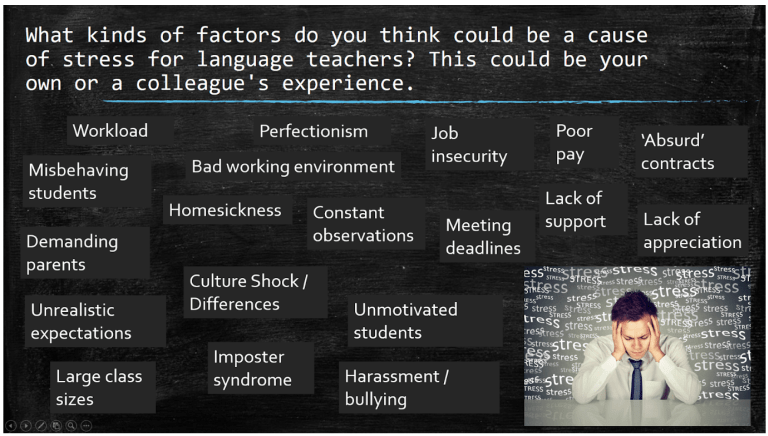 Incidentally, the slide below on ‘stress’ is the one that failed to open correctly during the webinar:
Q7. What is grounding technique?
A7. Grounding technique is a method of dealing with a ‘panic attack’. Panic attacks can cause feelings of disorientation, so it can be helpful to ground yourself. Your mind may be telling you to flee, but try to stay where you are and bring yourself into the present moment. The technique requires the person to not only have their feet on the ground but to feel them touching it, holding onto something such as a steering wheel. Connecting to something solid and being aware of this can help focus the mind and return the sufferer to normal. Mindfulness practice can help, too.
Q8. Because of my current mental state I am fired at my school. When I go for a job interview I mainly struggle if I should talk about it or not. Can you give me some guidelines? What should I tell them, and what is not necessary for them to know? I’ve got borderline depression and have been quite suicidal last year. Should I tell them everything or can I just talk about my depression only?
A8. This is a little bit difficult to answer because I don’t know about your individual context. Clearly your condition has had an impact on your employment and now you are wondering how much to tell a potential future employer. In an ideal world, you would be able to disclose your condition up front or following a successful interview, but I realise that this is not always the best approach if you are working in a cultural situation that may still see depression as some kind of disabling issue which will impact on your ability to do your job. That last sentence is written with the employers’ perception in mind – i.e. they might perceive that you will not able to do your job effectively enough or that you may have time off work etc. My guidelines would be to ‘test the water’ and find out from ‘human resources’ (personnel) – if they have such a thing – what could be expected if you disclose your condition and/or previous experience. Remember that plenty of language teachers are able to do their job perfectly good enough, despite having symptoms of one condition or another. I have had many months of inactivity and no earnings due to depression in the past. After a while, I was able to return to work, first by volunteering, to regain confidence, and then by taking on a part-time position where I did not feel pressure to perform. Good luck!
Q9. What are some words the employer can say to comfort their employee?
A9. In the webinar I showed the ALGEE model. The first step looks at worst-case scenarios. What you say to an employee once symptoms have been noticed or a problem has been raised will depend on the situation and the specific issues that the person is going through. It might be temporary, such as a panic attack, or a more long-lasting anxiety. An employer’s or line manager’s role is to listen non-judgementally and reflect on what the person is saying, not to bring too much of your own opinions into the conversation.
 You do not need to be medically trained to be able to give reassurance. Just recognise that something is happening and that the ‘threat’ that the employee is perceiving will pass and that there is a way forward. Reassurance about work or workload will be contextual. The last two are recommended because the majority of line managers are not trained to deal with this.
Q10. It’s not common to have students (specially children) with some mental illness in the classroom, but I’m thinking in some scenarios like the Panic Attack in the middle of a presentation of a students. Can we apply this guidelines effectively in the classroom?
A10. If it’s you, then walk away. If you are able to, explain to the students that you need to speak to someone. If you are unable to continue teaching ask for someone – a senior teacher or line manager – to cover your class. Let me them know when you feel better and panic has subsided that you can still teach, but if there are causes which you can identify try to talk about them, if possible. If a student has one, then I would not force them to continue with their presentation but allow them to ‘calm’ themselves down, with your help if this is possible. The main thing is to regain control of your breathing and deal with the physical symptoms first, before trying to talk about it. Students do experience some symptoms of some mental health conditions, most usually anxiety – over giving presentations – because of ‘performance’ aspect or tests. This has been documented by those involved in testing, although I do not have a reference to hand.
Q11. How can we face unrealistic expectations from top officials? It is most time becomes so stressful..
A11.Unrealistic expectations is one of the biggest causes of poor teacher wellbeing. It can lead to burnout. I mostly think of the expectation by ‘officials’ (employers) of student progression in a relatively short space of time. If possible, express your concerns to management. However, if every teacher is in the same situation, then managing stress is important, as a constant feeling of falling short of these expectations will impact on your own wellbeing, if you are a conscientious employee. Sharing stories and swapping notes with your teaching peers could help.
Q12. Shouldn’t all teachers have clear health insurance coverage wherever they teach, both for physical and mental problems? Teachers at commercial private schools have to demand that perhaps. What do you think? A teachers union is also an option for this.
A12. Speaking as someone from the UK, which has a National Health Service, I know that I am personally covered. It could be argued that mental health provision, support and funding does not have parity yet with physical health. It is an ongoing battle in the U.K. And I have been part of campaigns in this respect. When abroad there are plenty of countries where travel and health insurance are recommended. It is wise, but not compulsory in many situations. A teaching union is good and I think ELT Ireland are a great example of an advocacy organisation that protects teachers.
Q13. Do you know where we could access specific training on this topic, that employers might recognise and give us, for example, the role of being the designated person for staff members to talk to?
A13. It’s expensive. Mental Health First Aid England courses, in particular, cost a lot to do, even if the training you get would be second-to-none. I was advised not to call my webinar ‘Mental Health Training for Employers’ in case attendees thought that one hour and a certificate would make them suitably trained. Hence my truncated disclaimer at the beginning of it. I do think that having a designated person for staff members is a good. Some institutions are excellent. Just today I came across the University of Sheffield’s website in this respect. It champions and supports an open culture around this topic in the workplace. Having a designated or trained person in the workplace was one the main recommendations for employers that came out of my survey last year.
Q14. I used to teach in a country where there is political unrest, which affected all those who chose to stay in the country. In ELT contexts there, the teachers, students, administration and all were affected psychologically by what was going on. In this case, how can the mental health of teachers be taken care of?
A14. That question is very difficult to answer because so much depends on the situation, the country and what kind of unrest. I was teaching in Riyadh (Saudi Arabia) when a lot of teachers were flown over from Libya because of unrest there. The ‘Arab Spring’ was taking hold. The thought that Riyadh was a more hospitable place than Tripoli struck me as very strange. But the British Council were flying staff out for their safety. In situations when there is political change, guidance needs to come from the employer and national embassies, as this goes beyond the psychology of staff.
Q15. I am not sure if it is safe for the teacher and students to have teachers with some of the problems you mentioned to be in the classroom. Is it? The Classroom can be a rather stressful place that may trigger further problems.
A15. This is something I personally think about a lot and requires a good answer. Yes, the classroom can trigger problems – it is a stressful occupation for many. Certain working conditions and coping with cultural expectations can add to the pressures. But most teachers are conscientious about what they do, most care and take things personally when things go wrong. I think it is important to point out that teachers with diagnosed and undiagnosed conditions can do a perfectly good job. The risk of suggesting that the classroom is not a ‘safe’ place to be is that you continue to maintain the stigma associated with mental health. Obviously, if the teacher is either a danger to themselves, staff or the students then this should be taken seriously. That is why a greater understanding of conditions is required, as well as someone trained or a designated person who deals with this, not just a line manager.
Q16. Stamp on the spot?
A16. It is one of the suggested ways of distracting yourself and dealing with the physical symptoms of a panic attack. Take care of the physical side first, before trying to talk about what is happening or what just happened.
Q17. What’s the title of the book – that was visible in the background during the webinar?
A17. The two books I showed were ‘Language Teacher Psychology’ – edited by Sarah Mercer and Achilleas Kostoulas and Sarah Mercer and (2) A Beginner’s Guide to Being Mental – an A-Z: From Anxiety to Zero F**ks Given’ by Natasha Devon. In the past I’ve referred to Chris Eyre’s ‘The Elephant in the Staffroom’, too, and I recommend the work of Matt Haig, too, amongst others.

 Stephen Dodd is a teacher of some twenty-five years’ experience. He is currently director of English in Liverpool, a private school specialising in Project Based Learning (PBL).


 And most of all, talk to your colleagues about your ideas. When I shared my story with my colleague, Rob Howard, founder of EFLtalks – teachers teaching teachers, he came up with some brilliant tips of his own.
 Just today my student in Belarus, when I asked about his hobbies, responded “learning.” He said that after he had finished his PhD, he felt a hole in his life by not continuing to study like he did for school. I told him that he is inspiring. The student, whom I have needed to reschedule often due to my travel for conferences, answered quite simply, “I get inspiration from my teacher.”
 Oksana Hera is a freelance Business English Trainer in Lviv, Ukraine, and a Joint Coordinator of the


 ELT writer


 Emma L Pratt is a practising artist (


 Diversity and Inclusion
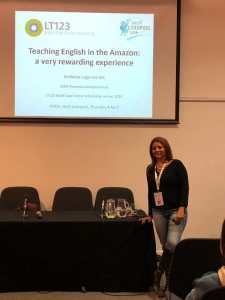
 Andreza Lago, This year’s LT123 Brazil State Sector Scholarship winner ,holds an MA in TEFL. She is a teacher, teacher trainer and materials writer. She has been in ELT for over 20 years. She is the author of “Tasks that work” and “Jogos Divertidos para a sua aula de inglês Vol 1 and Vol 2.